1. Favourite knob or fader or switch on a piece of gear and why?
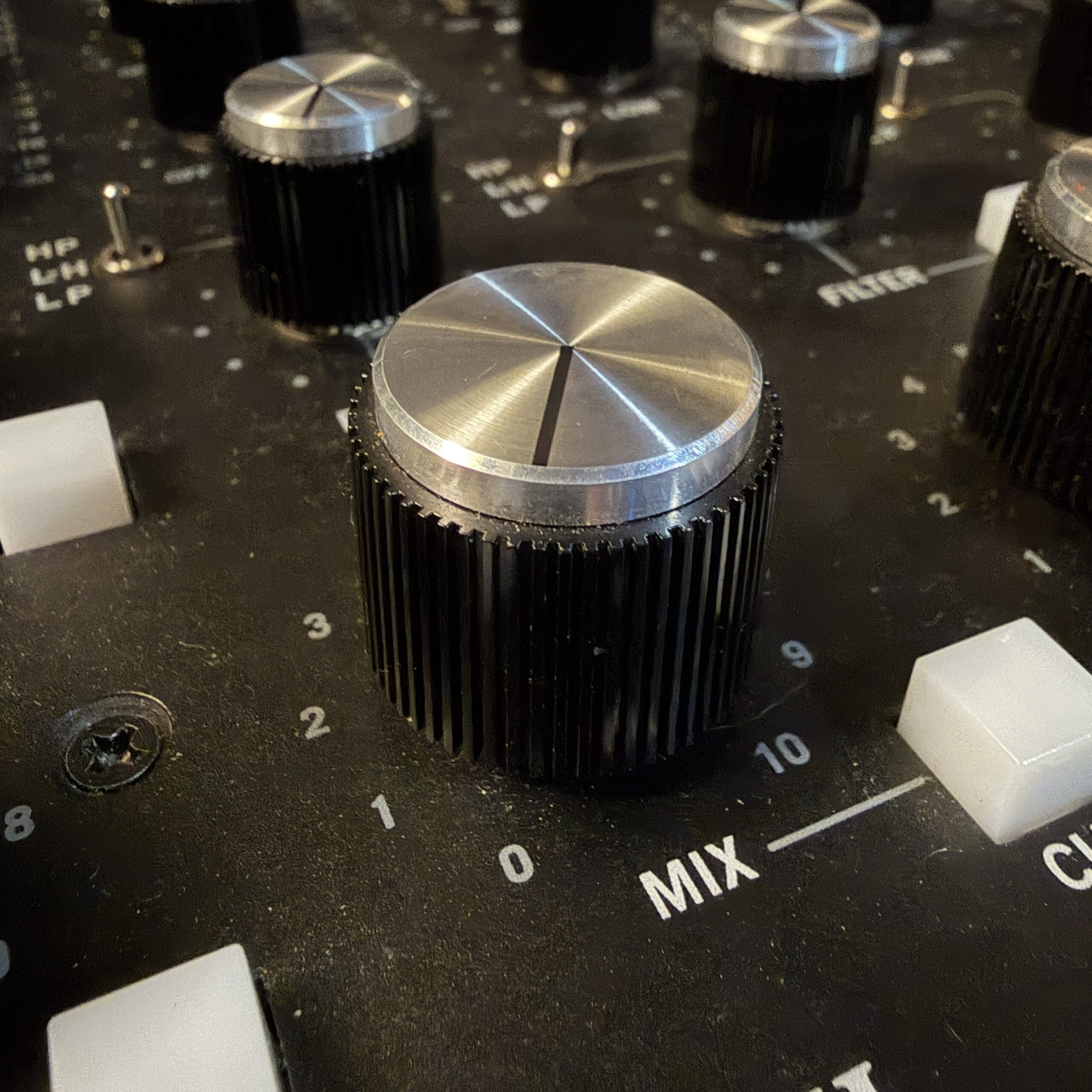
The large volume knobs on the Rane 2015 mixer – they are a combination of metal and rubber I think that’s the best it gives the solidness of metal and the isolation and softness of rubber. It’s a shame that often 100% plastic knobs are being used and if they wobble it feels really bad and cheap. The only plastic knob I like is on the 303.
Rane 2015 mixer
2. Do you have an ‘almost’ perfect bit of kit? What would you change?
The Erica Synth Zen Delay, I would use metal rubber knobs of course and add some CV inputs to be able to connect it with the modular synth.
Erica Synth Zen Delay
3. What setup do you bring on holiday or tour or commute etc.?
Nothing because holiday for me is about forgetting all things related to Techno
The truely minimal holiday setup
4. What software do you wish was hardware and vice versa?
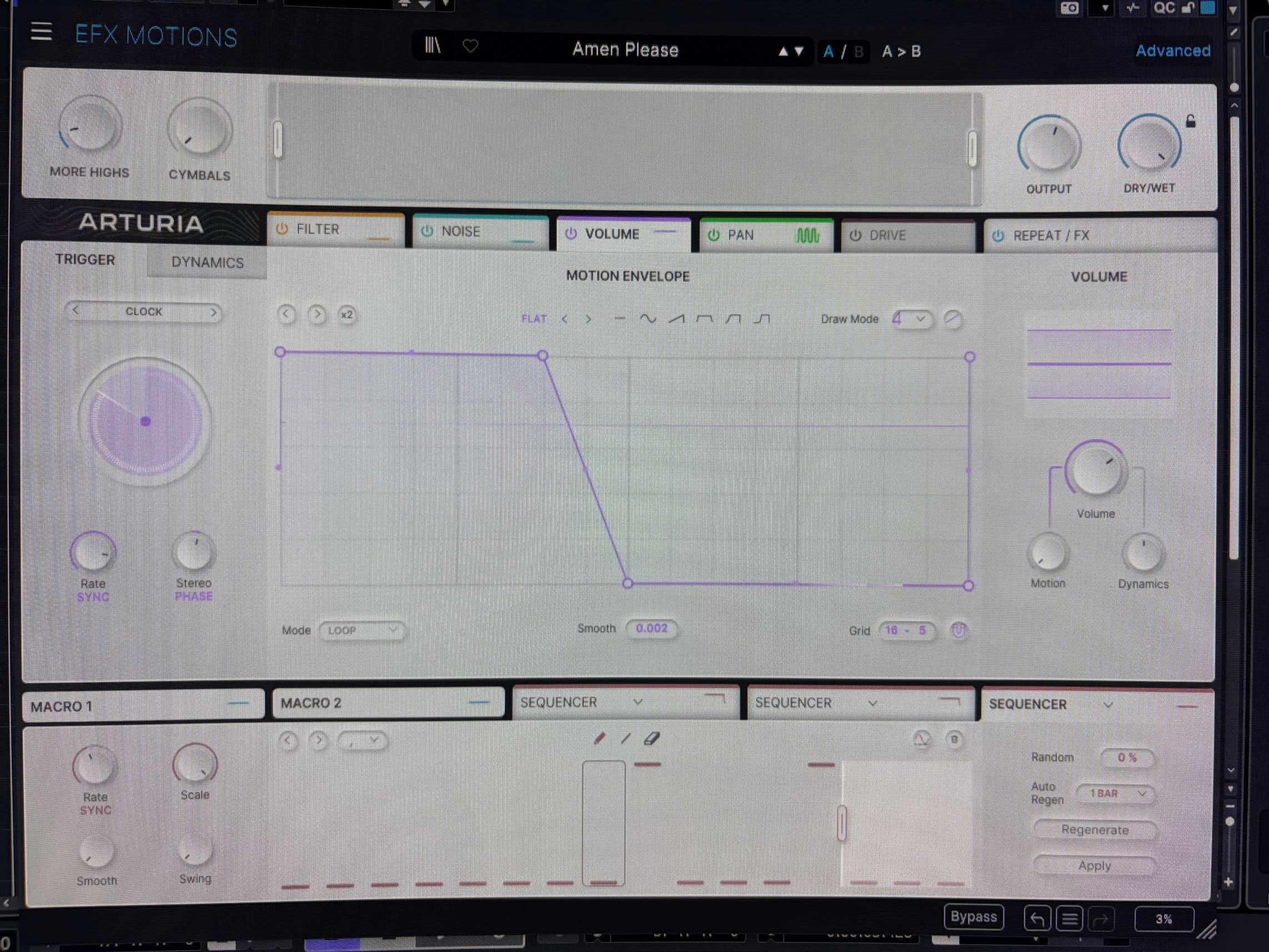
Arturia Efx Motion would be awesome in the hardware world in one box, parts of it can be built in the modular synth but it’s complicated and needs a lot of modules.
Arturia Efx Motion
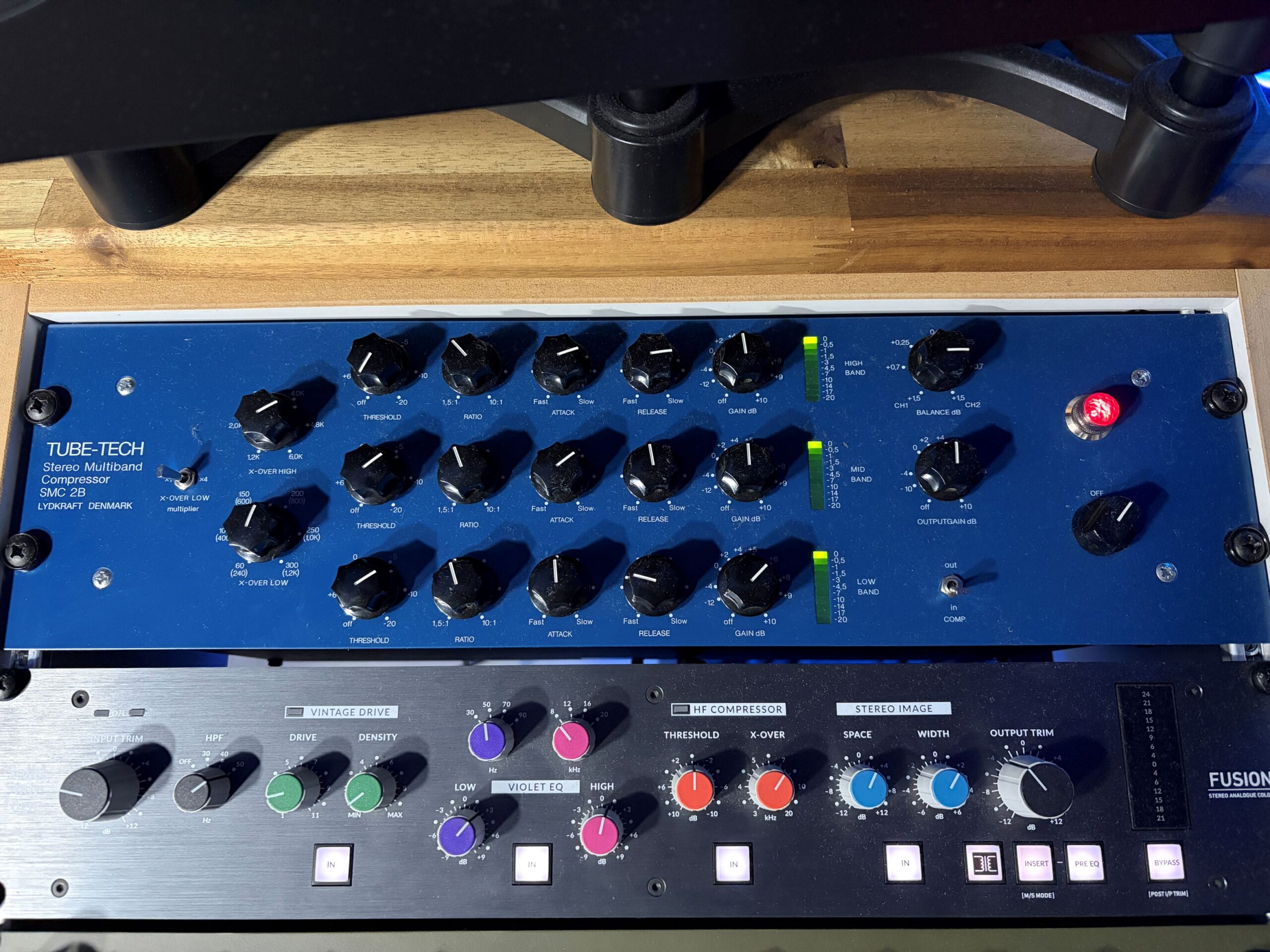
Hardware I think everything is already existing which I have but I use the hardware in case. Maybe the Tube Tech Multiband compressor but I guess there is a software emulation already.
Tube-Tech SMC2B
5. Is there anything you regret selling… or regret buying?
I sold 3 near mind Technics 1210 when I moved to Berlin in 2006 for all together 750€ and then I had to buy 3 turntables back years later in worse condition for the same price per turntable so 3 times as expensive. But I was not able to transport them back then anyways and I needed the money.
Spot the Technics 1210
6. What gear has inspired you to produce the most music?
The modular synth.
Eurorack Modular synth
7. If you had to start over, what would you get first?
If I had nothing then of course speakers (Eve Audio SC4070) and a budget Audio Interface and to start to produce music I would get Ableton plus some Riemann Kollektion Techno sample packs because it gives the quickest and best results for the investment – but the next thing would be stomp box effects and a modular case and modules and analog synthesizer. Last I would get outboard effects like compressors.
Eve Audio SC4070
8. What’s the most annoying piece of gear you have, that you just can’t live without?
The Boss KM-60 Mixer – it’s amazing for saturating sounds but it distorts very fast if the input is too loud and it has too much noise and mine also crackles if I move the volume knobs. But I would not sell it it does amazing saturation, wet soft and silky.
Boss KM-60 Mixer
9. Most surprising tip or trick or technique that you’ve discovered about a bit of kit?
An extremely simple trick not many people use but they should: Routing a copy of the output of a synth or headphone output back into an external input of the same synth – this way a really nice internal saturation can be archived. And also adding in this chain a stomp box like reverb, chorus or delay can give really nice or wild results.
Artist or Band name?
Florian Meindl
Genre?
Techno
Selfie?
Where are you from?
Austria
How did you get into music?
Heard House music mixed in the radio when I was 12
What still drives you to make music?
Simply the desire to have things I make with my gear recorded like a diary entry and the interest and curiosity to make something with analog gear and then also the reactions how other people perceive the results.
How do you most often start a new track?
With a synth sequence or a sound which can be the main theme of a track, let’s call it a seed
How do you know when a track is finished?
When everything flows and fits together and has the right things in the right time
Show us your current studio
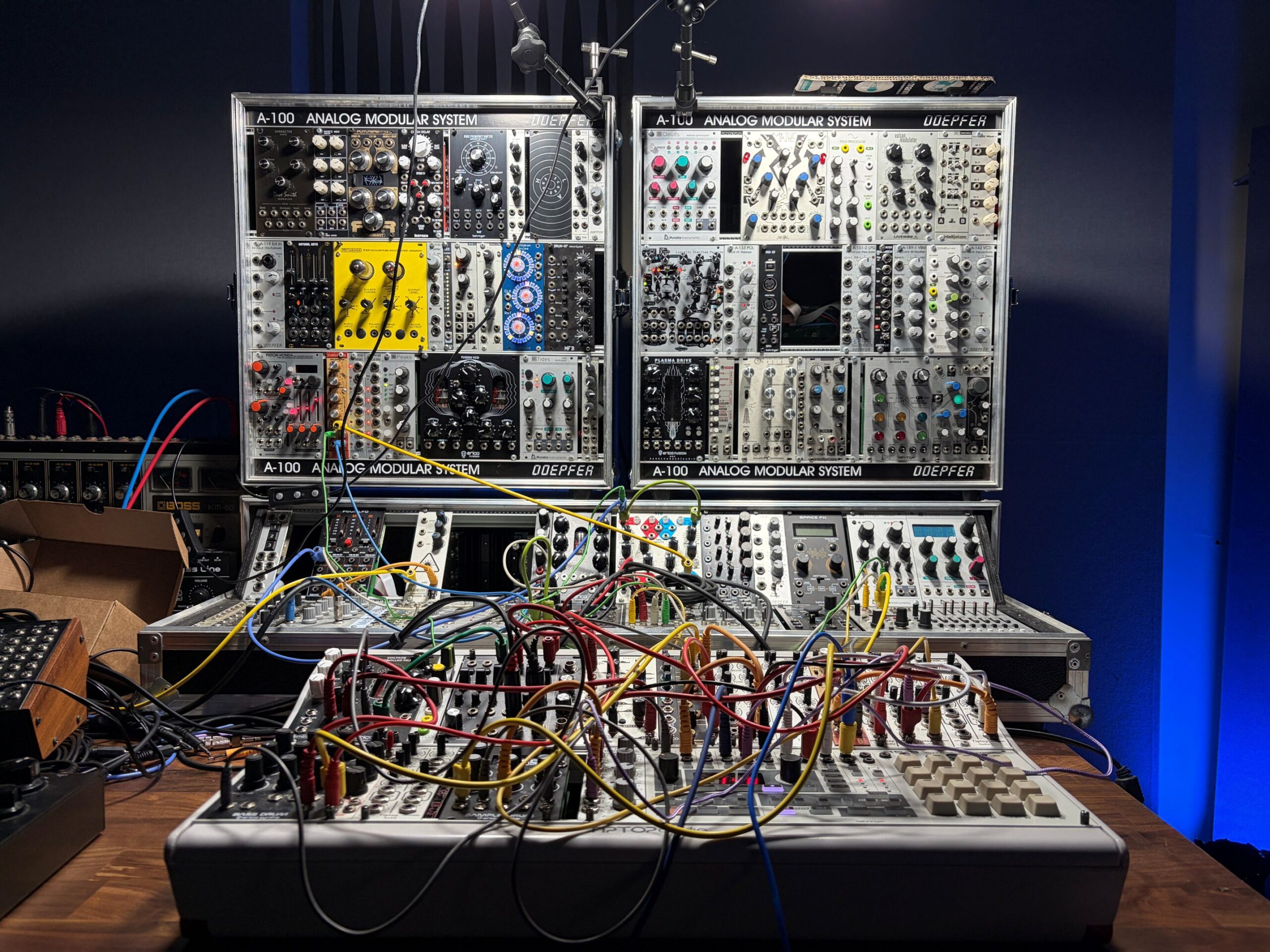
Florian’s studio
Best creative advice that you’ve ever heard?
Shape your taste by listening a lot of music and discuss either other people about it, then get to know your production process very well so that you don’t have too many technical problems while producing and then creativity will be there automatically because when you try something your taste will tell you where to go
Promote your latest thing… Go ahead, throw us a link
1. Favourite knob, fader, switch, on a piece of gear and why?
Doepfer A-103 filter
I have to say the cutoff frequency on the Doepfer A-103 filter. It captures something of the spirit and concept of the Roland TB-303 without being a clone, and within that it has its own character which I like very much.
2. Do you have an ‘almost’ perfect bit of kit? What would you change?
I love my Doepfer A-100. I would say that it’s almost perfect, or as perfect as it can be. It has a clear and practical design which I appreciate. What would I change? There’s always a battle for space in the rack, and I’m always having ideas about how I want to expand it with additional modules, but that goes with the territory. I’m going to have to think about a new case soon.
Doepfer A-100
3. What setup do you bring on holiday or tour or commute, etc.?
If ever I am on any kind of holiday I take my laptop with me, so I can work on composing, arranging, and processing beats. When I’ve played live I’ve kept it simple with a laptop, the Alesis Multimix 8 USB mixer, and a synth for live tweaking, like the Doepfer, or the Roland JP-8080 when I owned one.
Alesis Multimix 8 USB mixer
4. What software do you wish was hardware and vice versa?
It would be amazing to see Reaktor in hardware form, but to be able to zoom in and out like you can in the software, you’d need to be able to bend the laws of physics. I can’t think of any hardware that I’d like to see as software though. The amount of software plugin versions of different classic synths available now is amazing.
Native Instruments Reaktor
5. Is there anything you regret selling… or regret buying?
I borrowed a Roland SH-101 back in 1995, and I briefly owned one in 1997 before having to sell it several months later. It was the first analogue synth that I managed to get my hands on, and I learned so much from using it, putting the theory into practice, etc. I love its clear visual structure. I tend to do a lot of research into equipment before I buy it, so I don’t really have any regrets. That said though, maybe I would not have bought the Roland JP-8000 and waited for the JP-8080 rack version to come out.
Roland SH-101
6. What gear has inspired you to produce the most music?
Getting into analogue modular gear changed the way I approach producing music. I started off with modules that would give me a decent monosynth for synth leads, but as I have expanded, my approach has also widened. Sometimes a single experimental sound you discover can give a new tune its own unique character. You can think more widely about what sort of sound you want to build and test out ideas.
Eurorack modular Behringer
7. If you had to start over, what would you get first?
My first piece of gear was the Roland MC-303. It was a very good starting point. From that I got to familiarise myself with the Roland style of user interface. Sometimes I think I should have started out with a laptop with software for sequencing instead, but then I would not have gained the experience I did with the MC-303.
Roland MC-303
8. What’s the most annoying piece of gear you have, that you just can’t live without?
My laptop can be frustrating at times when it takes longer than expected to start up, especially when I have an idea in my head that I want to get down as quickly as possible.
9. Most surprising tip or trick or technique that you’ve discovered about a bit of kit?
Having four programmable input velocities on the MC-303 made me think about velocity levels, and by extension dynamics. From that I started to think about proportion and balance in everything from velocity and level in the mix to stereo panning, and I began to think of every element as relative to everything else in proportion and balance.
Roland MC-303
Artist or band name?
Snakestyle
Genre?
Electronica, ambient, chillout, downtempo, IDM, psychill, with melodic progressive textures.
Selfie?
Matthew Leigh Embleton aka. Snakestyle
Where are you from?
I’ve lived in and around South East London for most of my life.
How did you get into music?
When I was around 7 years old, I was given my first keyboard, and a vinyl copy of Oxgene by Jean Michel Jarre. It all started from there. I saw additional artwork and photos from the album with Jean Michel Jarre surrounded by all his analogue synthesisers and equipment, and I thought “I want to do that”. Electronic music seemed to offer a world of creative imagination that had not been previously possible, it looked like a world I wanted to be a part of.
First keyboard Yamaha PSS-133
What still drives you to make music?
It’s part of who I am and what I do. I still have things that I want to say with music, atmospheres I want to create, and sounds I want to experiment with, and to develop my sound ever further.
Moog Subharmonicon
How do you most often start a new track?
Most often I tend to build a track from the rhythm up. I get an idea in my head for a groove I want to create and build on. Then I add things, and then take things out until I’m happy. I’m interested in bridging the infinite space of potential with different patterns, schematics, logics, and systems. I create a framework with which to navigate the unknown. Sometimes I’ll pick a series of random BPMs and keys, and see what happens.
How do you know when a track is finished?
2600
When I am working on a track, I live and breathe it. It’s all I think about all day. I am constantly listening to it over and over again, thinking ‘what needs changing?’, ‘what is it missing?’, ‘what does it need?’. When I listen all the way through without finding anything that I would add, remove or change, I think ‘yes, that’s done’, or at least that it’s time to take a break from it, and come back to it again with fresh ears 24 hours later.
Show us your current studio
I worry that keeping all my gear set up in a particular way might inadvertantly limit or narrow my approach somehow. I often keep everything packed away until I get a strong idea of what I want to work on, and then I set everything up around that idea, using only what I need and keeping it simple.
Best creative advice that you’ve ever heard?
It’s not the amount of gear you’ve got, but what you actually do with what you’ve got. Try to favour building your own sounds over using presets. Don’t worry too much about sounding like artist X or Y, sound like YOU.
Promote your latest thing, go ahead, throw us a link
1. Favourite knob/fader/switch on a piece of gear and why?
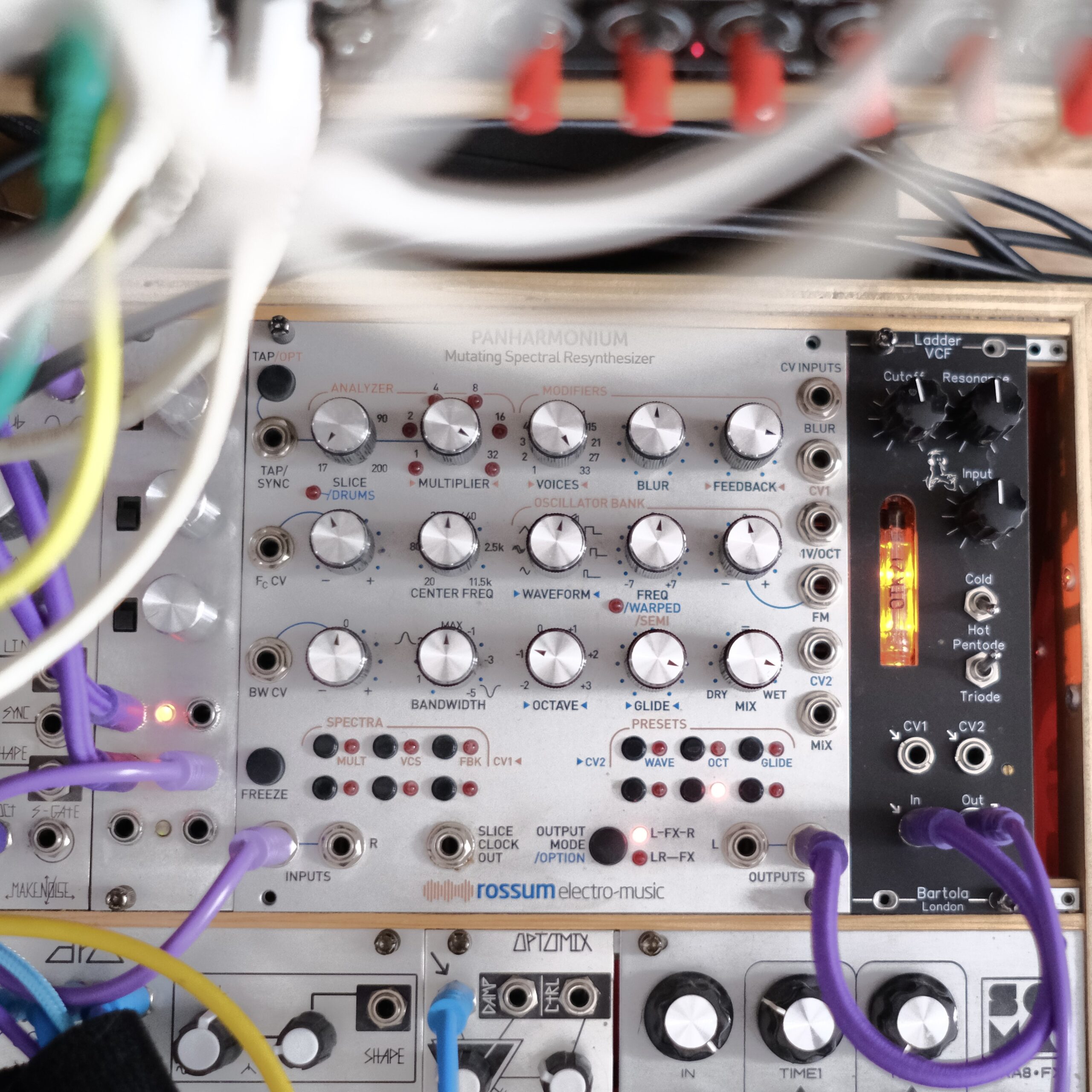
Panharmonium by Rossum Electronic
There are so many! I’ll go with the first one that comes to mind; The satisfaction of turning an arpeggio into a celestial pad in just a few seconds, it’s by turning the mix knob of the Panharmonium (Rossum Electronic) that you can achieve it. Layering is truly integral to my musical identity. And this module is just incredible for that purpose. There isn’t a piece where it’s not present.
2. Do you have an ‘almost’ perfect bit of kit? What would you change?
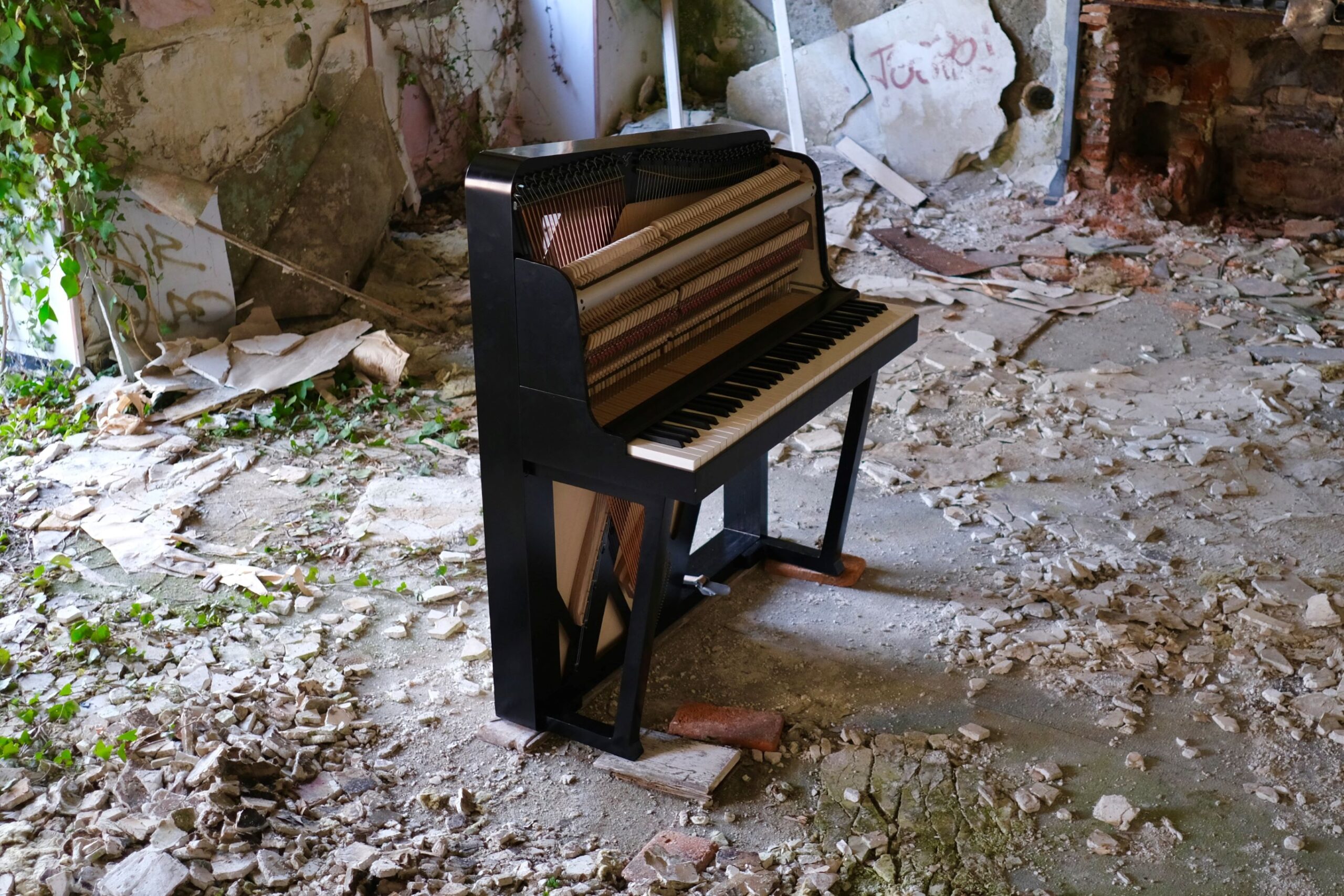
The piano is truly an indispensable instrument for me. I’ve been playing it since I was little. My mother “learned” to play it while she was pregnant with me. I truly believe that fetal life has an impact on who we are and become. She gave it up shortly after my birth. But for me, I’ve always been obsessed with this instrument. Just a single note is enough to plunge me into a very deep and intense emotional state. A year ago, I received the Keybird X1 from Keybird Instruments, which I had been eagerly awaiting for several months. It’s the piano of my dreams, lightweight, and portable. If I were to change something, perhaps I would add handles on each side to make transport easier and minimize damage. Also, among all the ongoing projects, I’m currently working on a pickup system for a piano/ modular synth collaboration.
Keybird X1 from Keybird Instruments
3. What setup do you bring on holiday/tour/commute etc.?
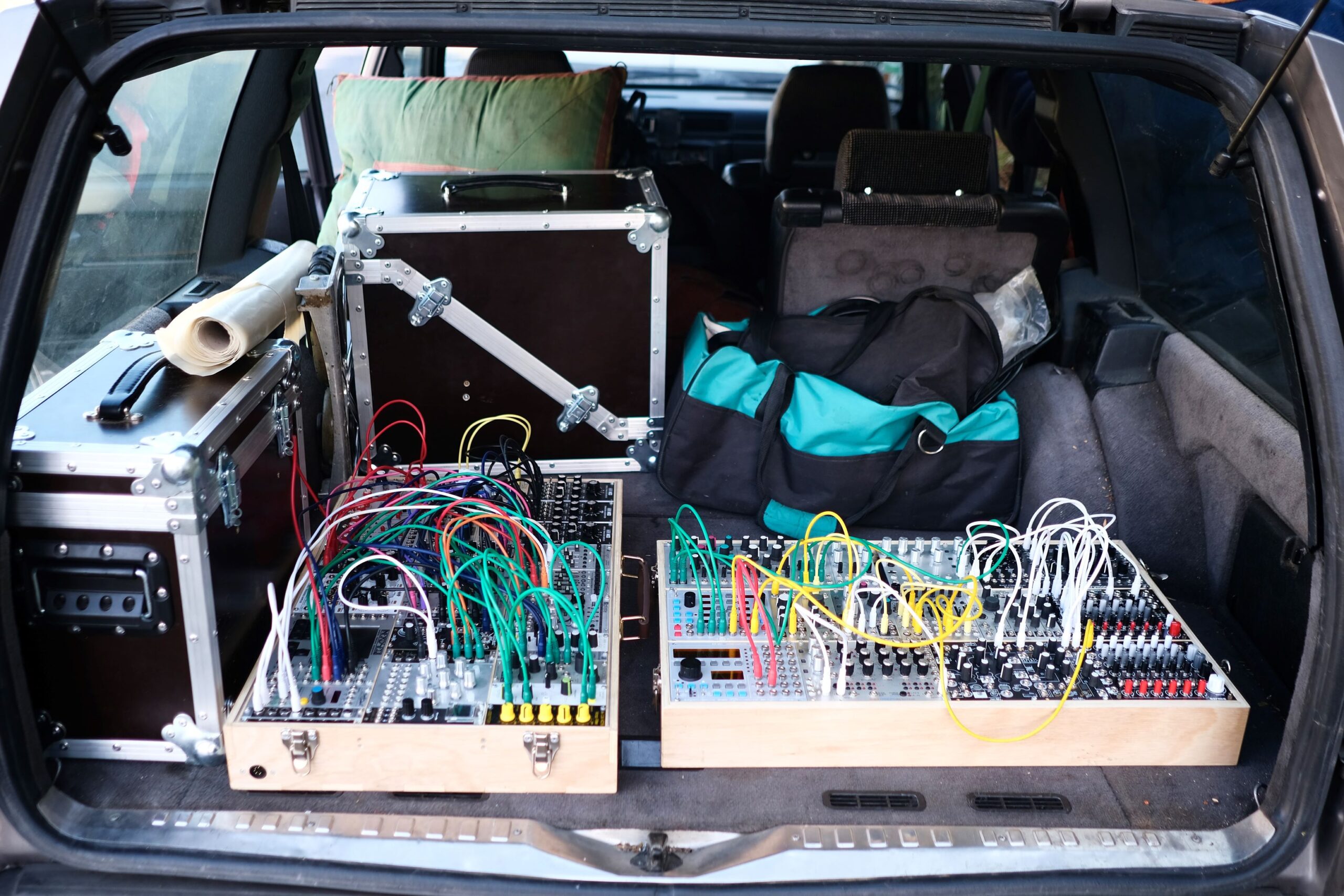
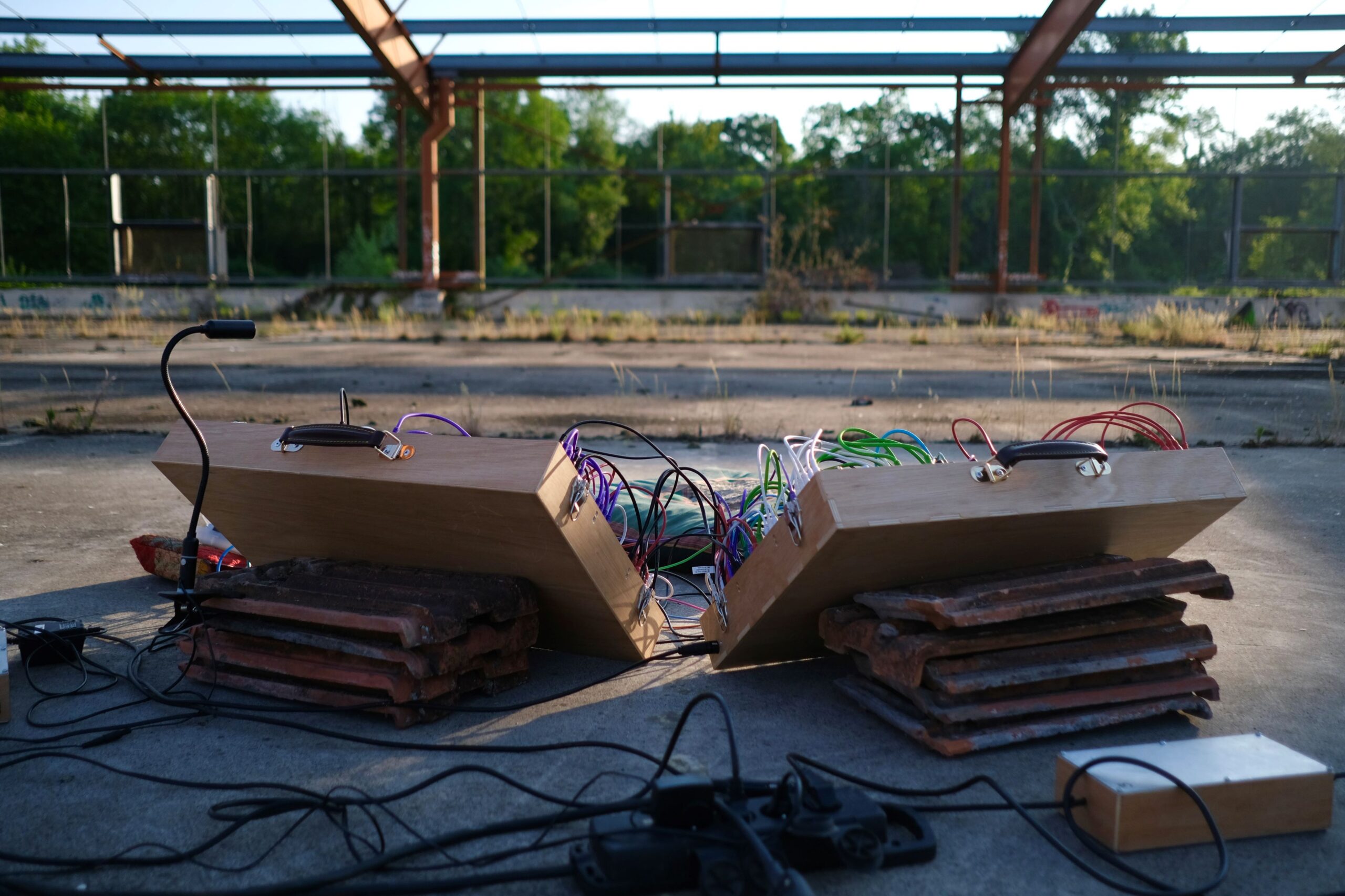
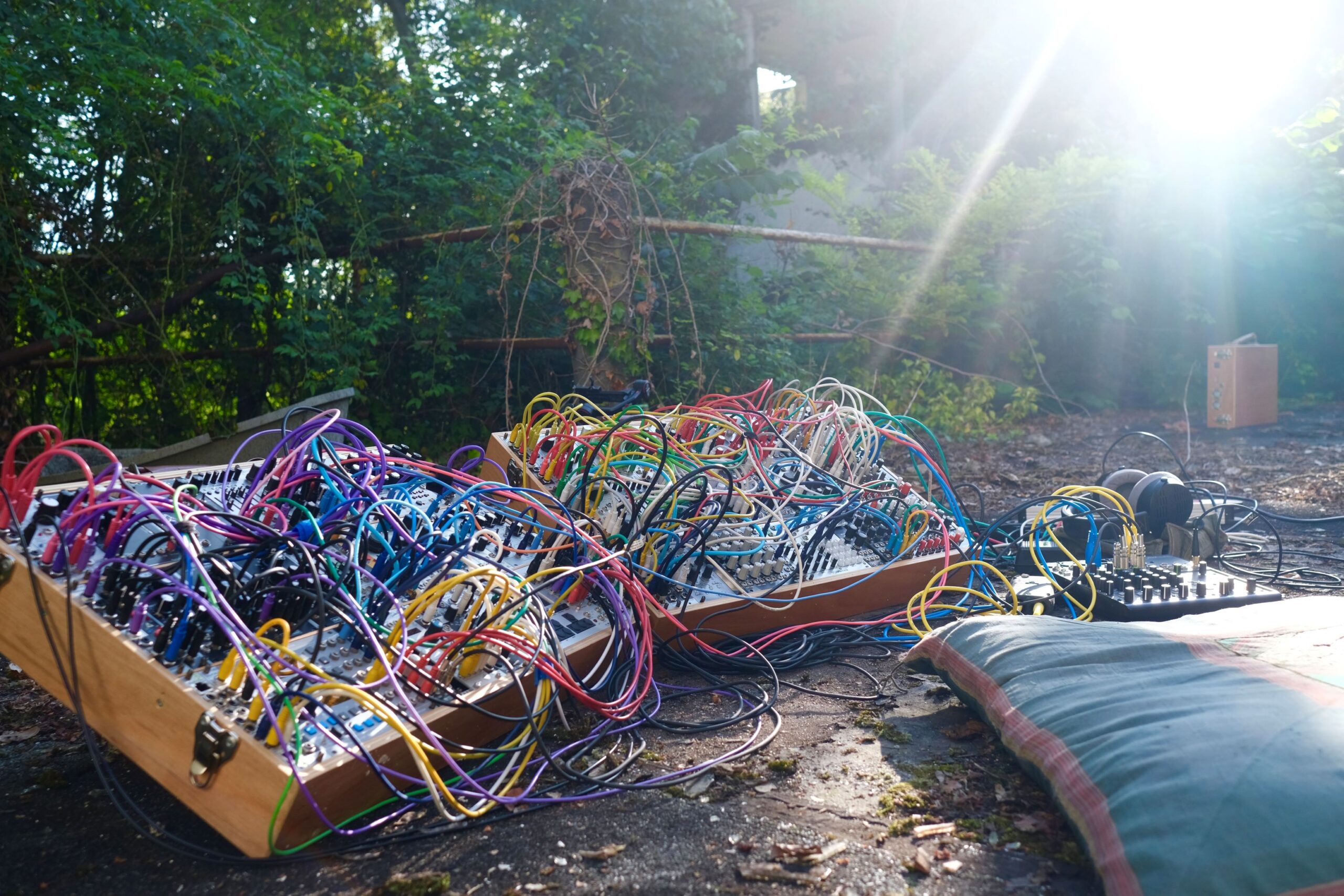
It’s been years and years since I’ve properly been on vacation, but when I travel, it’s never without my session setup; my two modular cases, my small Mackie mixer, my portable recorders, and the battery that powers all this little world. It fills up the car trunk quite a bit, I must admit, but nothing is impossible with my old Volvo; the modularmobile 🙂 I always have at least one recorder on me, to capture as many sounds and atmospheres as possible. A reflex that stayed with me after my video game sound design training.
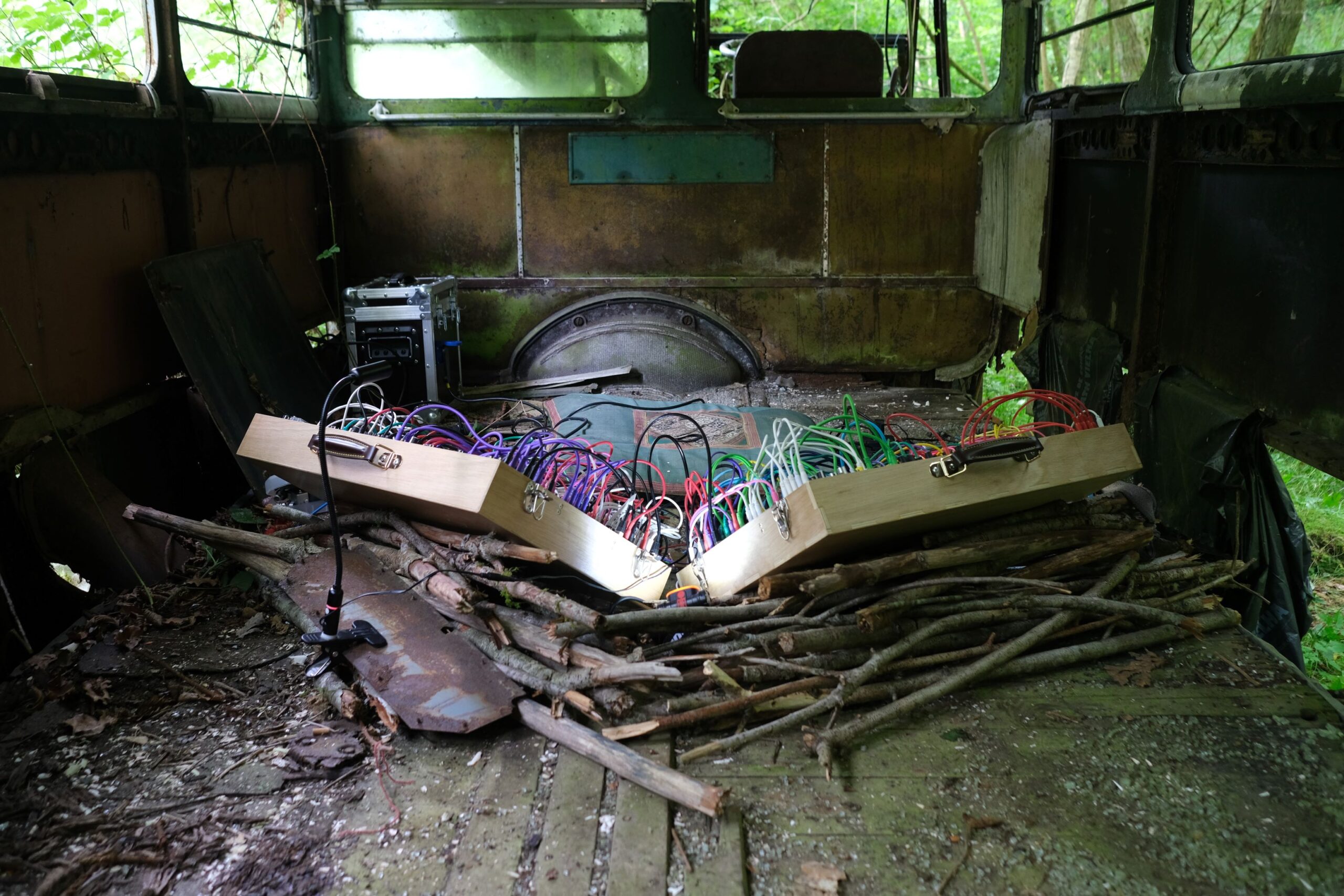
Two modular cases in the trunk of The ModularMobile
4. What software do you wish was hardware and vice versa?
To be honest, nothing comes to mind. Constraint and limitation are integral parts of my creative process. And it must be said that with all the current offerings in these two worlds, boundaries only seem to widen. That being said, I find it truly extraordinary that anyone can access a virtual modular rack, for instance, at a lower cost, to get hands-on experience, test modules, etc ..
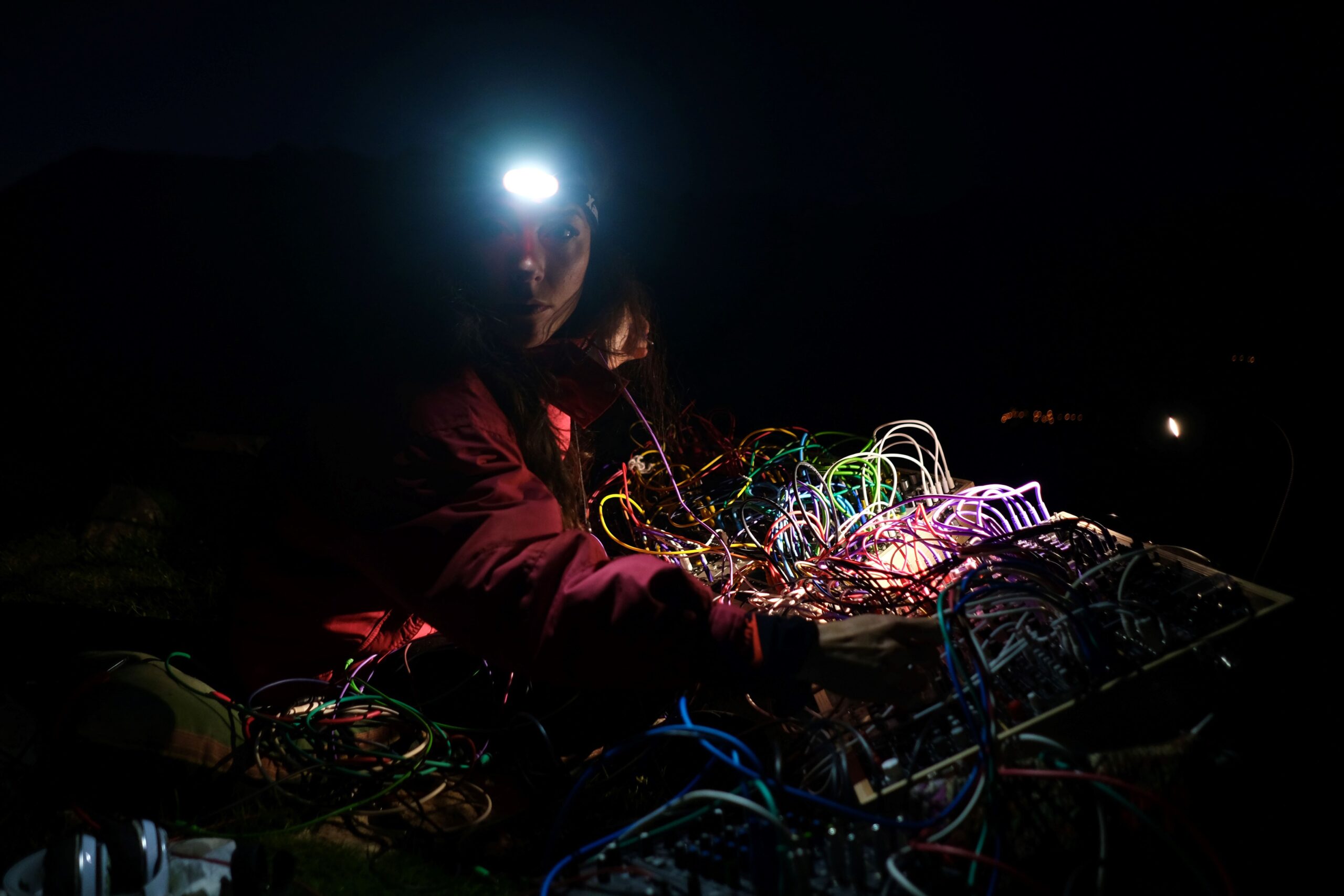
Hélène Vogelsinger spelunking for sound
5. Is there anything you regret selling… or regret buying?
I really have no regret concerning my gear journey. Each purchase has taught me a lot, and each resale has allowed me to make a new purchase. This cycle has been necessary for my learning process, the famous “trial & error” that propels us forward. It has also enabled me to make some very nice connections.
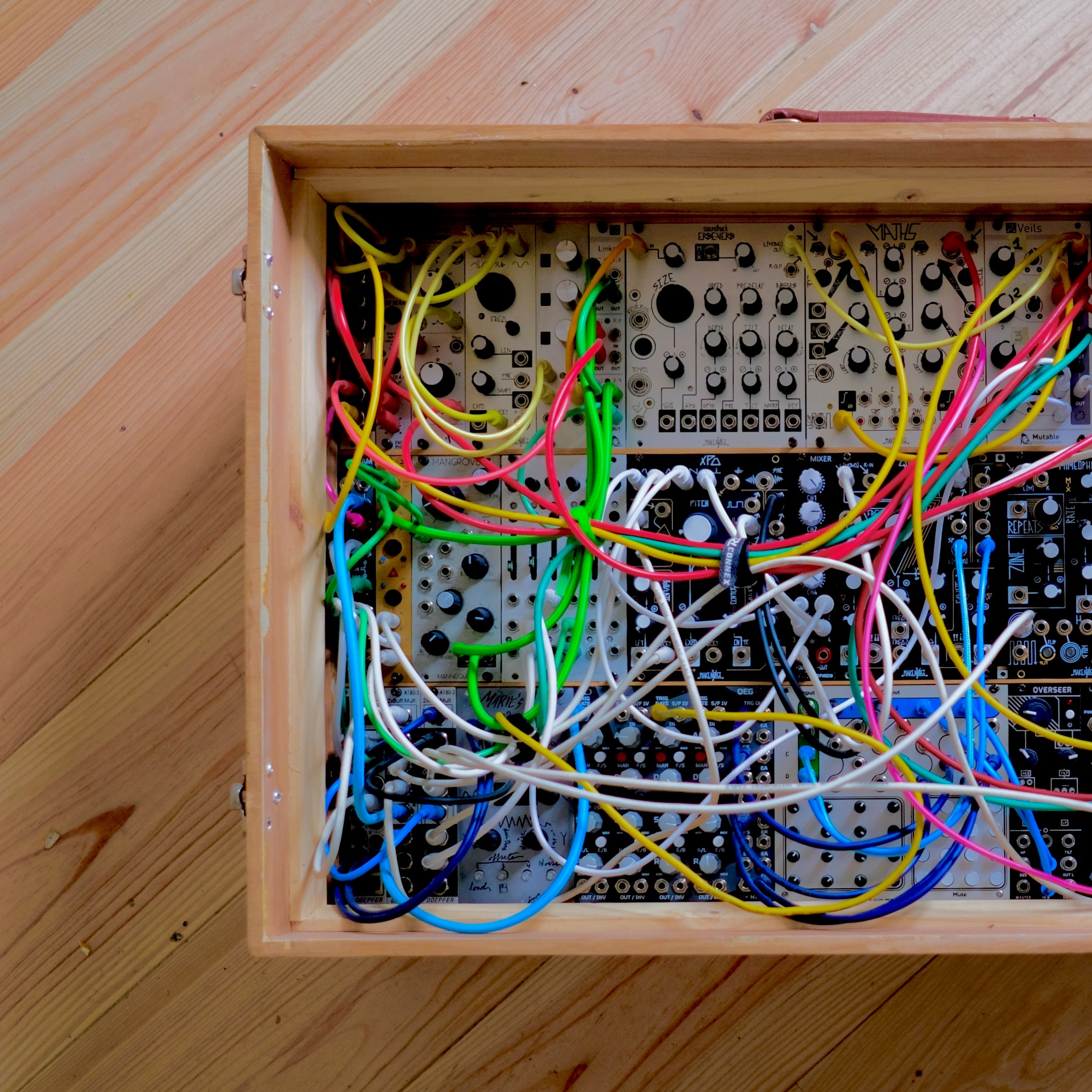
Twin modular
6. What gear has inspired you to produce the most music?
The piano and singing have always been at the core of my creativity, and I believe they will remain so until my last breath. Adding modular synthesis six years ago was truly a game-changer, allowing me to have a complete electronic orchestra at my fingertips. In my previous projects, this was always the direction I was heading towards. My latest project, which concluded in 2018, “Planetoid,” was a solo endeavor where I sang, played acoustic instruments, synths, used loopers, controllers.. and it was everywhere, becoming physically unmanageable, or at least severely limiting my ability to express what I deeply wanted. It also took up a lot of space and prevented me from engaging in current creative processes.
7. If you had to start over, what would you get first?
Eurorack modules and cables
I always think that if I had known about modular synthesis 20 years ago, it would have been something extraordinary. But not coming from an electronic background, it took all this time to get there. And nothing or no one along the way could have guided me. It happened purely by serendipity at a time when I reached a certain artistic and emotional maturity. But also at a time when I decided to go back to studying after a decade of experience on stage. A moment when I also felt stuck in my progress. And a moment when I completely changed my life. Also, I think I would have opted for quality soundproofing from my very first studio (a bedroom studio).
Ray of modules
8. What’s the most annoying piece of gear you have, that you just can’t live without?
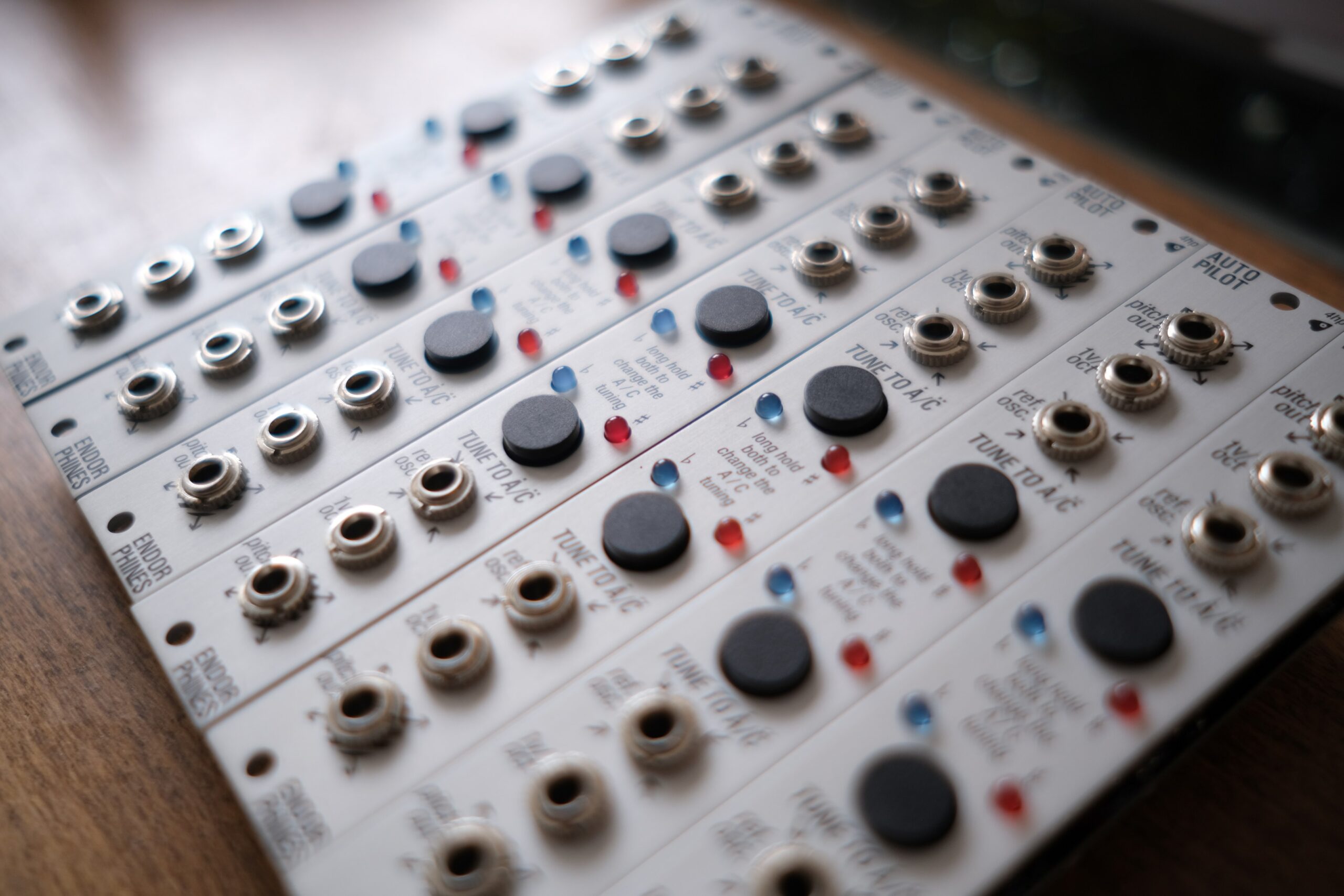
I think it’s my tuners. Indeed, they have only one function in my current usage, and not the most creative one! But they are truly indispensable, especially for long one-hour live sets, where everything can drift very far in terms of dissonance. Big shoutout to the Endorphin team, with their autopilots that make the task as easy as child’s play! That being said, they can also be a tool for creating creative patches such tuning-based modulation effects, tuning-based sequencing and control of granular synthesis or phase modulation.
9. Most surprising tip/trick/technique that you’ve discovered about a bit of kit?
It might seem a bit obsessive, but it’s about modular synthesis again. There are so many surprising and interesting techniques in this field. That’s what makes this instrument so fascinating – you never stop digging and discovering treasures. I remember not being able to sleep for months on end, my brain patching away at night, and waking up suddenly to jot everything down on paper.
A night full of modules
Among the hundreds of discoveries one makes when starting out with modular;
Resonant Harmonic Attunement : It’s a technique that harnesses the innate resonance of a filter module to create ethereal harmonics and unlock hidden sonic dimensions. By carefully tuning the resonance knob to a specific frequency, then modulating it dynamically with an LFO or envelope generator, the filter begins to resonate in sympathy with the fundamental frequencies of the sound source. This resonance amplifies certain harmonics while attenuating others, resulting in rich, evolving timbres that seem to breathe and pulse with life.
Feedback loops: By routing the output of a module back into itself or into another part of the signal chain, you can generate chaotic and unpredictable sounds that can add depth and character to your patches. Experimenting with feedback loops can lead to unexpected results and push the boundaries of traditional synthesis techniques.
Wavefolder and Waveshaper Exploration: Wavefolders and waveshapers are modules that can drastically alter the shape and timbre of waveforms. Delving into the creative possibilities of these modules can lead to unique and characterful sounds.
Random and Stochastic Sequencing: Introducing randomness and probability into your sequences can yield unpredictable and evolving musical patterns. Utilizing modules such as random voltage generators, sample-and-hold units, and probabilistic sequencers can result in dynamic and constantly changing compositions
Cross-Modulation and FM Synthesis: Experimenting with cross-modulation and frequency modulation (FM) synthesis techniques can produce rich and harmonically complex sounds. By modulating the frequency of one oscillator with another, you can achieve a wide range of timbral variations and textures.
Complex Envelope and Function Generators: Utilizing modules capable of generating complex envelopes and functions, such as AD (Attack-Decay) and ADSR (Attack- Decay- Sustain-Release) generators, can add depth and movement to your patches. These modules can be used to shape the amplitude, timbre, and modulation of your sounds in intricate ways.
Exploration of Nonlinear Signal Processing: Modules that perform nonlinear signal processing, such as wavefolders, ring modulators, and distortion units, offer unique opportunities for sonic exploration. By pushing signals through these modules, you can create harmonically rich textures and unearth new sonic territories. Don’t be afraid to experiment with unconventional patching techniques and signal routings. Thinking outside the box and exploring unexpected connections between modules can lead to surprising and innovative results.
I could go on like this for hours, as the possibilities for discovery are endless. But what surprised me the most when I discovered its existence is its ability to substitute for an orchestra. To reach the orchestral patch as I practice it today, it took years of research and experimentation. This process has been incredible, a real journey, whether it’s the search for modules or their practice. In the first two years, I systematically unpatched my system after each use to discover new things every time. This technique really allowed me to know my instrument almost inside out, because despite the thousands of hours spent, there is still so much to learn and discover.
Artist or Band name?
Hélène Vogelsinger
Genre?
Immersive & orchestral ambient electronic music
Selfie?
Hélène Vogelsinger
Where are you from?
I am French by nationality, and have been based in France for a little over 10 years now. Due to my parents’ profession, we moved around quite a bit when I was growing up, my parents, my three brothers, and I. I spent a significant portion of my life in Beirut, Lebanon. I returned to Europe at the age of 19, with the sole aim of pursuing a career in music. At that time, the music scene in Lebanon was not as developed as it is today. I actually went back for a short tour in 2017, where I witnessed the great evolution that had taken place. It was truly a beautiful and moving experience. I was deeply affected by this intense period in Lebanon, which had a significant impact on my way of being, living, and composing. For musical projects, I then lived in England, and eventually returned to France, first in Paris, and then in the southwest of France, where some of my family resides. Perhaps the only place where I have some roots. It was one of the best choices of my life. Sort of an unconscious decision, following a burnout in Paris, where I struggled quite a bit, juggling odd jobs that allowed me flexibility in my schedule, thus giving me time for my musical projects and performing on stage in the evenings. The cramped spaces, the lack of nature, the economic constraints caused by the high cost of living, and the hustle and bustle of big cities (which I really appreciate in small doses) eventually took a toll on my morale. It was a very instructive journey nonetheless, and I wouldn’t change a thing if I could.
How did you get into music?
The voice was my very first instrument. I have been singing and composing on the piano since a very young age. So, as you can imagine, my very first compositions at the age of 5 were not very complex. At the same age, I began learning solfeggio, piano, and flute for 5 years. This training was put on hold when we moved to Beirut, but I continued on my own. Indeed, I never stopped singing, playing, or composing. However, this period was more of an accumulation of what I call « inputs »; all these new sounds that are only found there, the wonderful oriental music and its approach. But it was also a time of intense new experiences, such as repeated bombings, the war in 2006, but also, and especially, constant human warmth, that magnetic ground, that desire to embrace life to the fullest, that confidence in the future despite the difficult times and uncertainties. These were great lessons in humanity, humility, and resilience. It took me many years to readjust to the West, the expatriate syndrome and return one. It’s thanks to music and art in general that I was able to find a balance, allowing me to express all these experiences, but also encounters, people who held my hand and showed me the way when I was disoriented by all these changes.
What still drives you to make music?
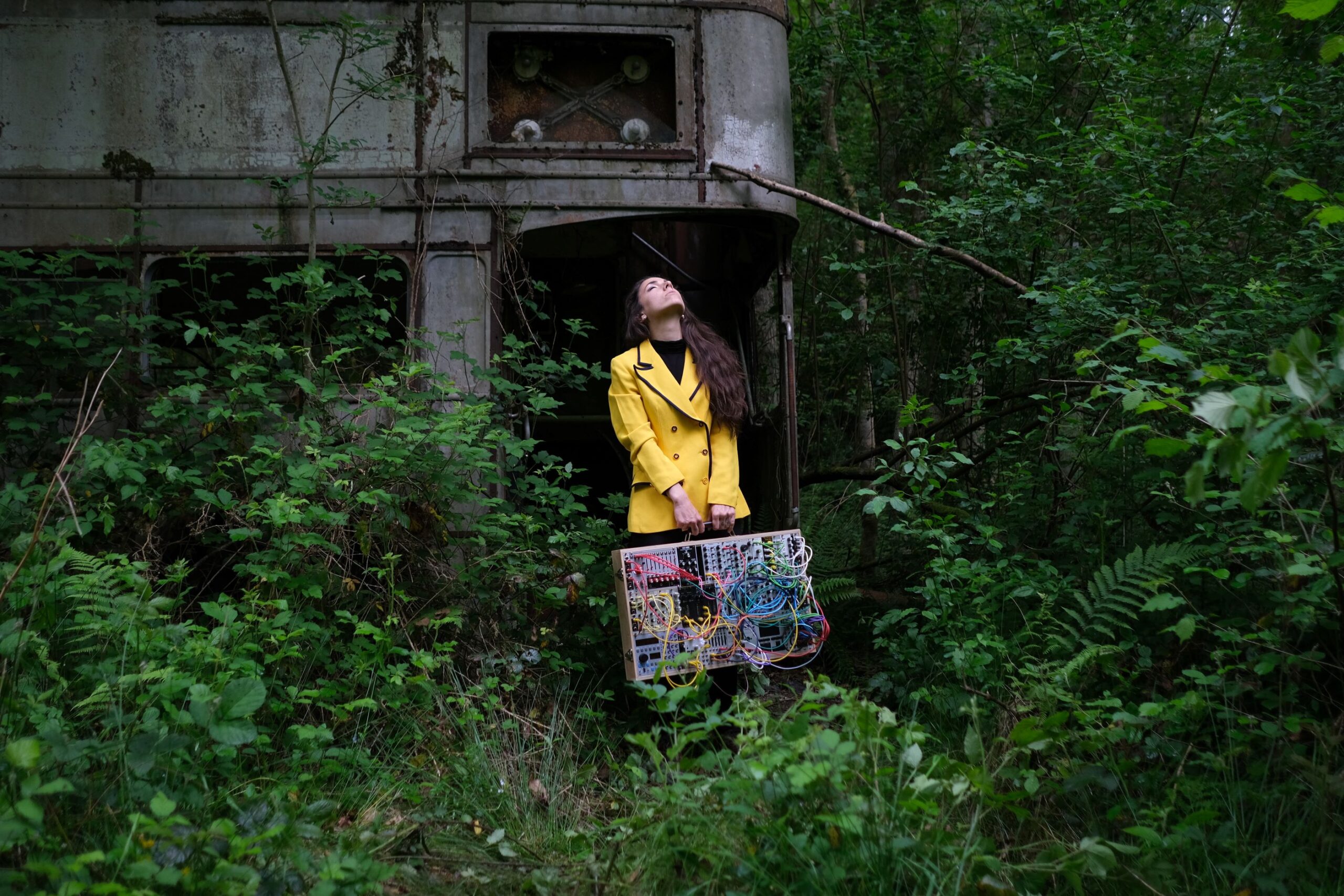
Hélène Vogelsinger in the wild
The search for something deeper than this material existence. Through this guiding source, this force that has inhabited me since forever. I’m sure many artists and enthusiasts of all kinds understand when I say that I can’t do anything else, that it’s my life’s path, my ‘mission.’ Some may find this word a bit strong, but that’s how I feel. My family, who comes from a non-artistic background, took some time to understand it, but when we reunited 7 years ago, in the southwest of France, and they witnessed my dedication, things really changed. Having the unconditional support of loved ones, people we love, and who love us in return, is priceless. It’s an enormous strength. Especially on this path strewn with obstacles that is professionalizing in any art in general.
How do you most often start a new track?
In recent years, it’s after visiting abandoned, depopulated places, far from civilization.Their memory, the passing of time, and the energy they emit have been at the heart of my inspiration. Indeed, since 2019, I’ve embarked on creating a very specific process that unfolds in several stages (location scouting, first exploration, transcription, layers of perception). In terms of composition, and thus the transcription of the experience, it often starts with the piano and voice. This is how the pattern or melody is composed, which becomes the foundation, the essence of the composition. And everything else is built around it in a very organic way. I find myself in a state of ‘Flow,’ where space and time cease to exist. There are no difficult calculations behind all this. It’s like being the instrument of an invisible force, a downward movement, an energy that permeates my entire being, only to rise again. It has always worked this way.
How do you know when a track is finished?
In the context of my creative process, and thus when we record a session, it’s when it reaches its conclusion that the piece is truly finished. But in terms of composition and “orchestration,” the stage preceding the session, it’s an intuition. I know it. I feel it. It’s a feeling of fulfillment.
Show us your current studio
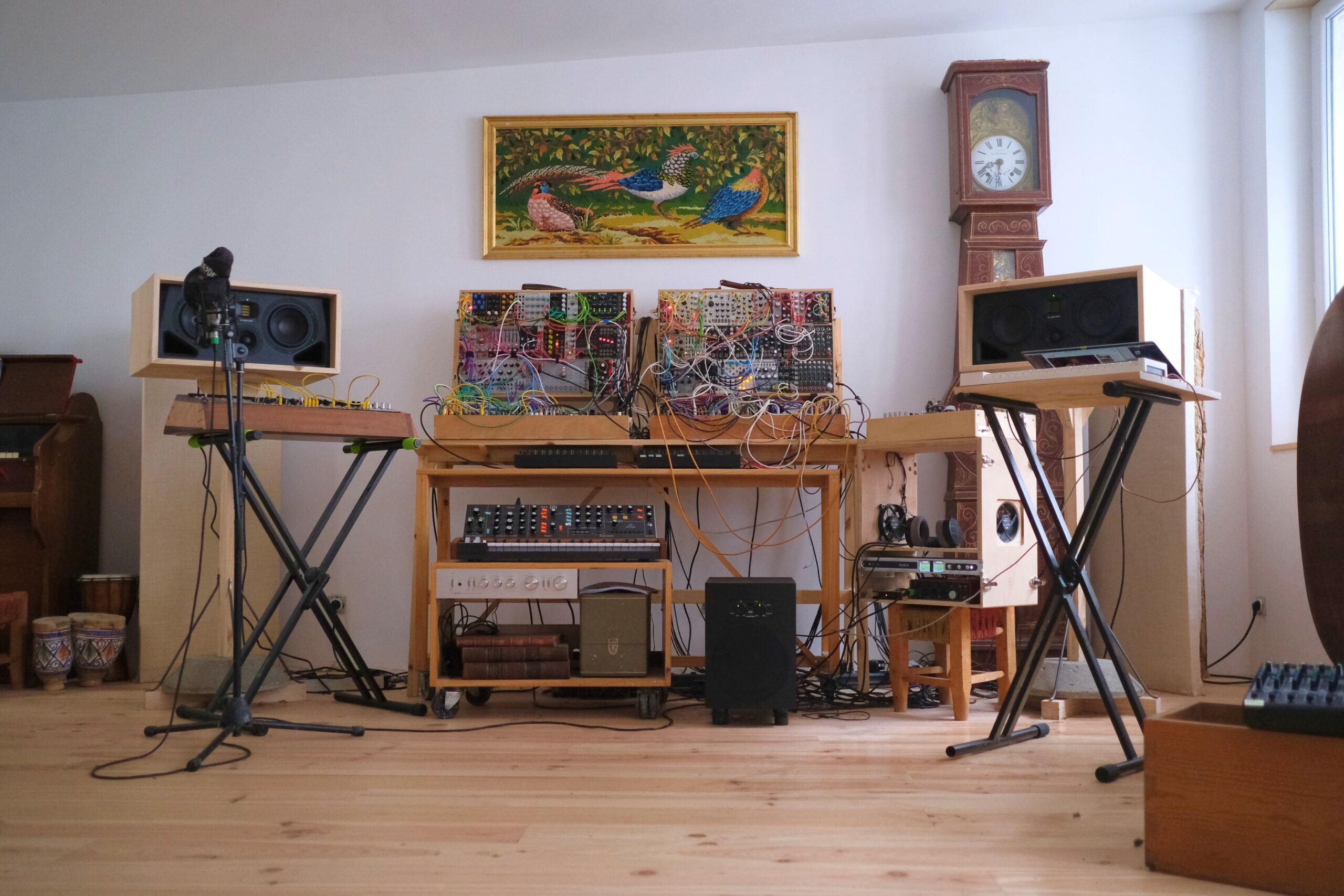
Hélène Vogelsingers Studio
Best creative advice that you’ve ever heard?
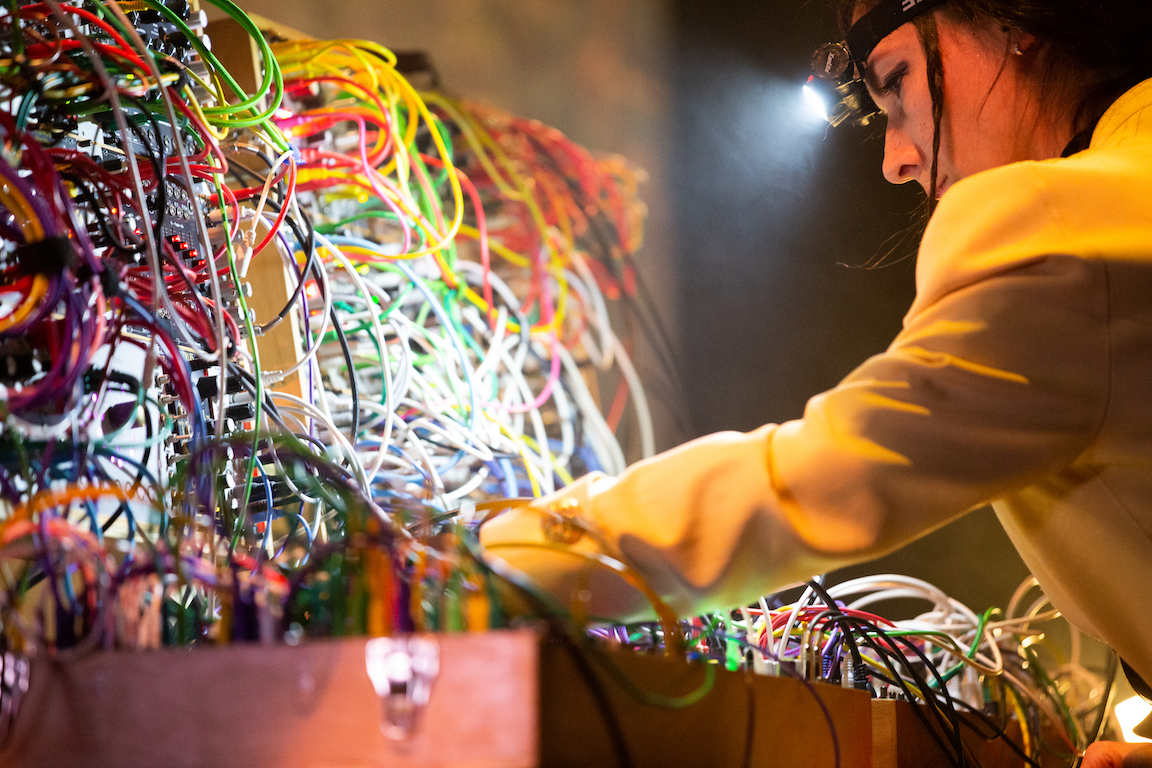
Embrace the process, not just the outcome. While it may seem peculiar, I’ve found profound wisdom in a self-imposed directive that I’ve diligently adhered to, particularly in the realm of crafting and refining my creative process. However, I must attribute this insight to a confluence of factors, including personal experiences, trial and error, and the invaluable guidance from my mentors and peers. One particular catalyst was a course on ‘unusual recording’ that I undertook at Berklee College of Music, which significantly propelled me out of my comfort zone roughly five years ago. It’s a profound reminder that creativity is not merely about achieving a specific goal or producing a masterpiece; it’s about immersing oneself fully in the act of creation, embracing the journey of exploration, experimentation, and growth. By focusing on the process rather than fixating solely on the end result, we free ourselves from the constraints of perfectionism and self-doubt. We become more open to taking risks, making mistakes, and learning from our experiences. This mindset shift not only fosters a deeper sense of fulfillment and joy in our creative endeavors, but also enables us to tap into our true potential and express ourselves authentically. Ultimately, it’s the journey of creation—the moments of inspiration, the challenges overcome, the lessons learned—that shapes us as artists and allows our creativity to flourish in ways we may never have imagined.
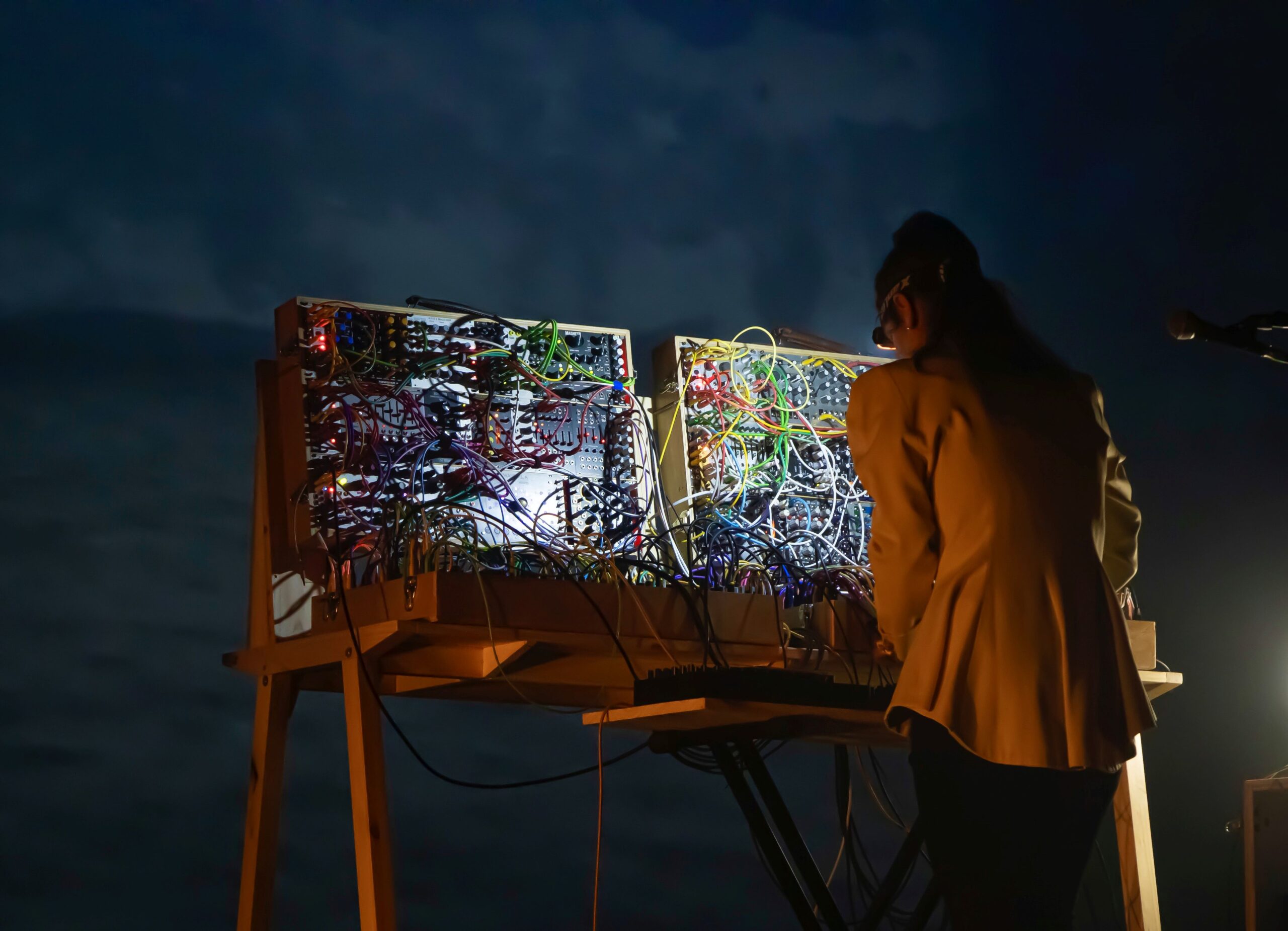
Hélène Vogelsinger at the modules
Promote your latest thing… Go ahead, throw us a link.
I’m just going to share with you my YouTube channel where I’ve been documenting my creative process for several years. It’s a place purely focused on artistic and spiritual exploration. I hope it can bring you some inspiration for your own journey, as others have done for me.