Frank Pedersen – EuroCrack Soundscaper

1. Favourite knob/fader/switch on a piece of gear and why?

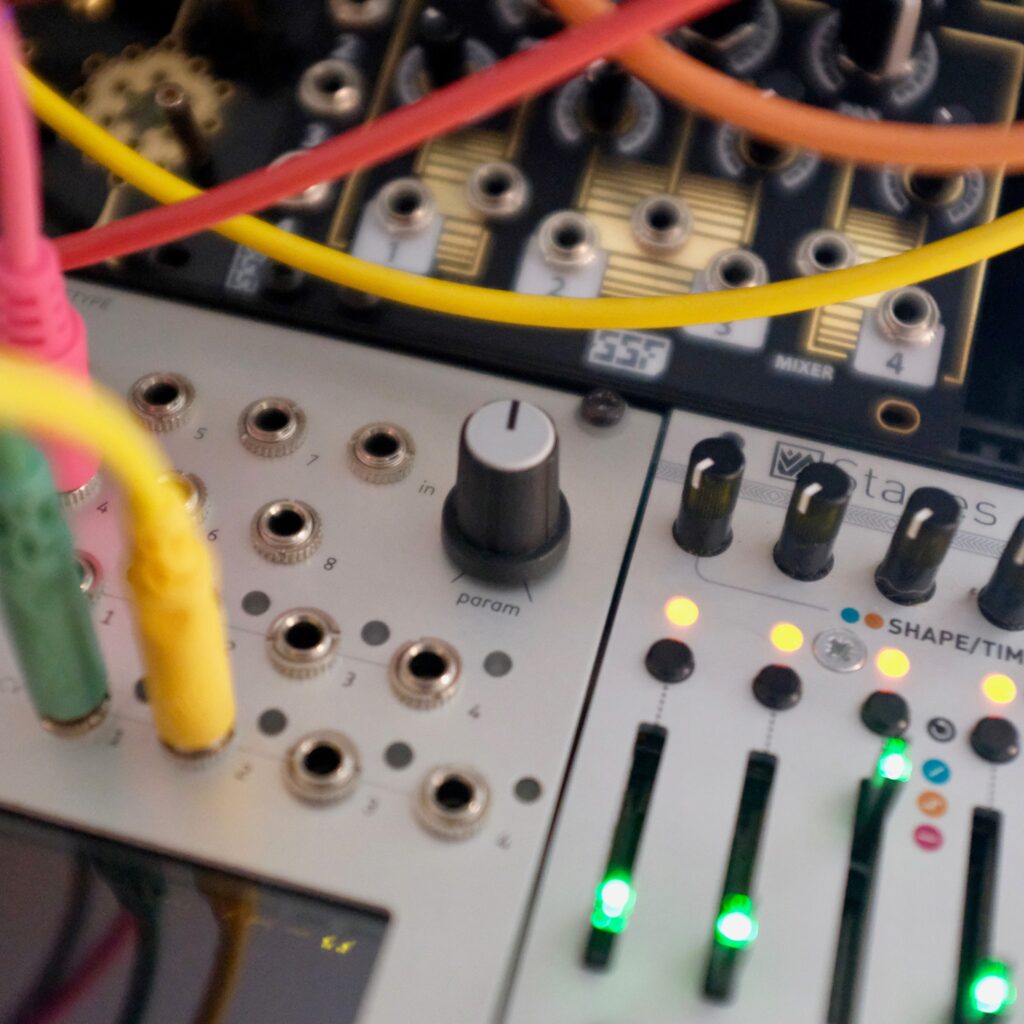
From eurorack modules, I really like the white knobs on Vermona and the keys on the NerdSeq is just fantastic. Both Modules have a good build quality. Also the patch cables from Instruo and Vermona I really enjoy using because they are great quality.

NerdSeq tracker sequencer in the center of the picture

2. Do you have an ‘almost’ perfect bit of kit? What would you change?
Well yes, but mostly no 😉 I primarily use eurorack, so there is always coming and going modules in my system, but that’s a big part of the fun in eurorack, at least for me. Last year I bought around 140 -150 modules and sold maybe around 100. I cleaned out a lot and tried getting rid of the modules that didn’t fit my workflow and purpose. I’m currently down to 1750 HP which I feel is a good size for my home studio. [Editor: May I, on behalf of all the readers, say ‘Woa!’]

FourMulator from Vermona

3. What setup do you bring on holiday/tour/commute etc.?

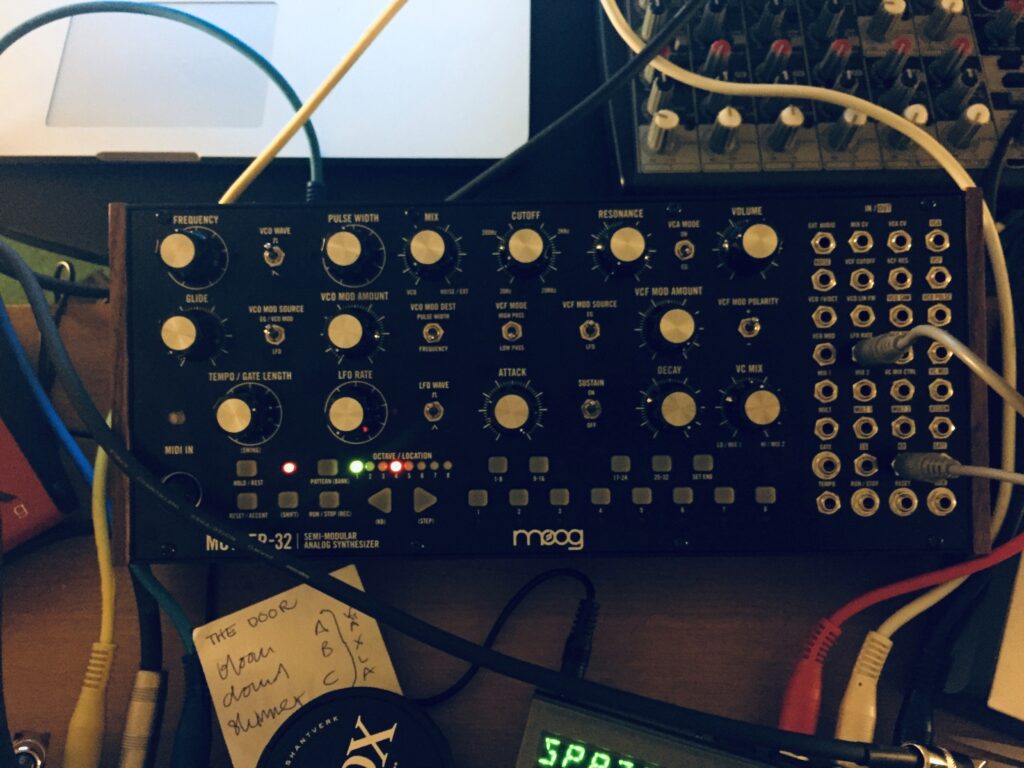
Holidays?? For Modular meet-ups I used to carry a medium and a large flightcase, plus a big backpack with cables, but it turned out I damaged my back by carrying this. So for the time being i’m down to a 60 HP case from 4MS. I think I will get the Intellijel Palette soon though. It seems to have a good size for a small backpack.

My first homemade flight cases. The small one was used for a Mother32 and a few modules

4. What software do you wish was hardware and vice versa?

Orca from Hundredrabbits. It can run on Monome Norns, but the display is small and it’s not eurorack. I would really like a dedicated hardware module with a large screen for that. I don’t wish for any modules to become software.

Orca from Hundredrabbits

5. Is there anything you regret selling… or regret buying?

Yeah a lot of things.. Roland TR8s was surprisingly awesome, and I regret selling it. (Did you know that you can multitrack record the channels on the TR8’s directly to your DAW with usb. It’s quite awesome, most synth boxes just pop up as a Stereo Master). Hermod and Pyramid from Squarp, OTO BAM, Orthogonal Devices ER-301. And of course all my 12 Amiga’s I had through time. I really wish I still had them all. Regrets from buying, sure, lots. There will always be many regrets when buying eurorack modules no matter how well you research modules. Period!

6. What gear has inspired you to produce the most music?
It’s kinda of weird, but I was fascinated by RF noise since I where a kid. For space sound textures I like the CW-upper sideband and CW-lower sideband the most. Running it thought various filters never disappoints me. Lately I’ve been “resynthesizing“ it through Panharmonium, and it can create some crazy wicked sounds, as well as nice random melodies.

Panharmonium from Rossum (picture taken the day I got it)

7. If you had to start over, what would you get first?

From standalone synths I would most likely buy Syntrx from Erica Synth and Tracker from Polyend. On eurorack modules I would start with what I know is good for me. NerdSeq, Trident, Panharmonium, and various standard modules. I have a long list in my head 🙂

Trident from Rossum

8. What’s the most annoying piece of gear you have, that you just can’t live without?

Besides the obvious; my computer. Then it is the Clouds and Rings. I currently don’t have either, but I have a Rings on the way again 🙂

Samsung 49” 32:9

9. Most surprising tip/trick/technique that you’ve discovered about a bit of kit?

I guess it is what I mentioned before. Any RF noise from an AM radio and the Panharmonium or just some nice filters. Wasp and Belgrad are great for this.


Artist or Band name?

Franksemi

Genre?

Interstellar soundscapes & ambient

Selfie?

Uffff.. but ok

Franksemi

Where are you from?

Denmark, Northern Jutland, Countryside. Raised by my Grandparents.

How did you get into music?

My uncle was teaching me how to play guitar every Sunday afternoon from when I was around 6 years old. But I lost interest in that after a while and somehow I also managed to break the guitar in half.. I don’t remember how and why, but I most certainly remember making up a cover story, so that my Grandparents would not get angry at me 😀 I can’t believe they fell for the story. I put the guitar back together as good as I could and placed it between some heavy wooden boxes so that it looked like the boxes had fallen and broken it… haha 🙂 Then I moved on to bass, and then tried drums for a bit. I also got tired from that pretty fast. Then when I was 13, the Amiga popped up and I was hooked on Protracker for some years. Later I got access to a 303 and borrowed a 606 for a while. Then it was mostly software for many years and next a 15 year break from making any music. Three years ago I split up with my x-girlfriend after many years together, and I needed to do something creative again, so I started building my first Eurorack flight case. And from there I started with Eurorack which was something I wanted to do for years.

My third homemade modular flight case

What still drives you to make music?

I don’t know if what I make is considered music, at least not in a traditional way. I would just categorize it as making space soundscapes & textures for my own personal meditative pleasure, and that is really what drives me. That and making something creative, which I have always done one way or another. I always imagine myself how I would enjoy these sounds while leaving this solarsystem in a spaceship. Plainly put; sounds for space travel. But I also think of it as kind of alien communication that I am still trying to learn. Sometimes I would call it ‘Sound Design’ but that’s probably a stretch 🙂

How do you most often start a new track?

I just start a new patch and see what happens.

How do you know when a track is finished?

I never finished a ‘real track’, at least not for many years. I often just make patches and let it run for a couple of nights, sometimes a week or more. I like falling asleep to that, instead of just putting on some random DI stream etc. Most of time I don’t even bother to record it, cuz it is too much of a hassle and I often have problems with getting the levels right etc. But sometimes I put a small video clip on Instagram, but not so much anymore.

Show us your current studio.

Franksemi’s Studio

Best creative advice that you’ve ever heard?

When I was in Art academy in Kolding 25 years ago, I had a teacher that told me that the best art is always something you made 20 years ago. That was funny back then, cuz I asked if he meant, that I made art like a 5 year old. But no, seriously, depending on how you will interpret it, I think this can apply to music as well. I will let you think upon that for yourself.. 🙂

Promote your latest thing… Go ahead, throw us a link.

You are very welcome to follow me on Instagram: https://www.instagram.com/franksemi/

[Editor: Eurorack modules: Too much or Never Enough? Leave a comment below. ]


Jens Paldam – Buchla Buddy

1. Favourite knob/fader/switch on a piece of gear and why?

Turing Machine
Turing Machine by Music Thing Modular

Here I am on the same blog as Tom Whitwell (Editor: Read his answers to ‘9 Odd Questions’ here) and I must mention his Turing Machine. It is one of the most brilliant modules out there and the knob that sets the balance between random and looped is nothing short of genius in all its simplicity. I have it sitting right next to Mutable Instruments Marbles (though I have owned the original, I currently use the Antumbra CARA version to save precious hp). Marbles is another brilliant module that expands on the core idea from the Turing Machine. The two of them are often patched together in a feedback loop that forms the foundation of many of the patches I create.

2. Do you have an ‘almost’ perfect bit of kit? What would you change?
The Buchla Multi-dimensional kinesthetic input port model 223e is somewhere between a keyboard and a sequencer. It is extremely playable. With it, one never runs out of control voltage sources. You can dial in the CV value for each key, so any scale or tuning system can be applied. The one thing that would be great was if the CV value wasn’t restricted to whole numbers, since the note I am trying to reach often lies somewhere between two whole numbers :/

Buchla Multi-dimensional kinesthetic input port model 223e

3. What setup do you bring on holiday/tour/commute etc.?
I usually bring my Buchla Skylab case. I have this nice soft bag for it and it can be packed while patched up.
There is always some programming of the 223e I can do, something that is nice to do away from the distractions of my other studio gear.

4. What software do you wish was hardware and vice versa?
I worked with several hardware samplers over the years, but with the software sampler HALion from Steinberg I thought I had found my main sampler. When I started using modular hardware, I stopped using samplers all together, but about a year ago, I got hold of an Assimil8or from Rossum Electro Music. Though it might not be as comprehensive as a software sampler like the HALion or Native Instruments Kontakt, it has some great features that makes it an amazing tool in a modular context, like sampling of CV, phase modulation, scrub and shuttle, CV control over bit depth and aliasing. It is an amazing module.

Assimil8or by Rossum Electro Music

5. Is there anything you regret selling… or regret buying?
I had a TR-808 that I sold some 15 years ago for about 1000 euros. I don’t really miss having it, since I hadn’t lived in Detroit in the eighties and wasn’t amongst those who had thrown their love on a discarded second hand machine, using it to realize their dream of changing the world through a unique vision of how the future should sound, but I regret not holding on to it for a little longer because now it is worth three times what I sold it for. Basically, I am on the lookout for something that is unique for my time and can help me achieve something with the same level of originality as the 808 and the techno created by the maestros from Detroit.

6. What gear has inspired you to produce the most music?
Sorry for the predictable and boring answer, but probably just modular gear in general. When patching, I can “invent” my own instrument particular to whatever track that I wish to create. This description might also apply to other types of gear or software, but with modular, everything starts like an experiment. It is to me, infinitely more inspiring and creative than choosing a software instrument and then browse through and modify the presets until I find a sound I like.

Jens Paldam’s Eurorack Modular

7. If you had to start over, what would you get first?
Modular hardware, like maybe a Doepfer system. Learning about modular is learning about the elements of electronic music in the right order. When I got my first modules, working with music software suddenly felt like a flight simulator compared to modular, which is like being in the cockpit of a real airplane 🙂

8. What’s the most annoying piece of gear you have, that you just can’t live without?
Not sure that I have any gear that annoys me. The one thing I can think of is the Rossum Control Forge. It is in every sense an amazing module – it takes the concept of the Buchla MARF to the next level. But since it is so advanced, I often have to reach out for the manual, so I guess that is one of those “good problems”.

9. Most surprising tip/trick/technique that you’ve discovered about a bit of kit?

Roman Filippov Buchla 208 Clone

I have a Roman Filippov Buchla 208 Clone. I absolutely love the way it sounds, and wouldn’t change it for a “real” Buchla 208, even if I got paid to do it, but one thing that bothered me was that I didn’t have control over the envelope section’s attack and decay, that was until a friend of mine pointed out that patching CV into the ‘from prog‘ and ‘to prog‘ does exactly that.


Artist or Band name?
Jens Paldam

Genre?
Leftfield

Selfie?

Jens Paldam in his happy place

Where are you from?
Aarhus, Denmark

How did you get into music?
I started playing the guitar when I was seven.

What still drives you to make music?
I can’t stop. I love it. I once asked myself the essential question: What is it you want? Do you want to put your efforts into making a name for yourself or do you want to put everything into making music that gives your listeners an experience? You might think that the two are not mutually exclusive, but he who chases two rabbits rarely catches one – as the Japanese saying goes.

How do you most often start a new track?
I make a field recording somewhere and get an idea. Other times, an experiment on the modular becomes the foundation of a new track.

How do you know when a track is finished?
When it starts to feel done, I let it sit for a while without listening to it. That is the only way I can come close to that valuable fresh ears experience.

Show us your current studio
Here is a photo of the bulletin board I have above my studio desk. I often look at it and let my thoughts drift while listening to a track I am working on, so the content changes frequently.

Mood board of meditating modular mind

Best creative advice that you’ve ever heard?
Anything worth doing, is worth doing well.

Promote your latest thing… Go ahead, throw us a link.
My YouTube channel is youtube.com/jenspaldam

But I also think you should do yourself a solid and check out Chris Cutler’s excellent podcast series “Probes”… I learned so much from it.

[Editor: Jens recently did a lovely ‘driven’ ambient set at Chiba City Museum of Art in Japan. Check it out below]


[Editor: Do you have a favorite tip, trick or way of working with any of the gear from this interview?
Then throw a comment below…
]


Gustav Rasmussen – Synthing The Horn

1. Favourite knob/fader/switch on a piece of gear and why?

AMT Expression Pedal

I would say my mission engineering expressionator + my expression pedal. A lot of the time, I use my hands to make music, so having a knob under my foot is super useful. And with the expressionator, I can use the same expression pedal for a number of different pedals, and on top of saving space on my board I can use it on several pedals at once. For me the expression-pedal is so important because I can play around with a lot of different musical parameters while I am playing – so it gives me a great connection between the acoustic and the electric.

Mission Engineering Expressionator

2. Do you have an ‘almost’ perfect bit of kit? What would you change?

Trombone

My trombone. The sound is wonderful and it’s in great condition even though it’s pushing 60 years old now. If it doesn’t break in some way, I will still be playing it in 60 years time 🙂 However: the one thing I would change is to implement some kind of pickup system. It is a constant work-in-progress scouring the internet, talking to other horn players etc. and I have tried a number of systems (clip-on mics, piezo-pickups soldered to the mouthpiece, practice mutes with microphones) but they usually fail in either sounding crappy acoustically or not being well suited for effects. I’ll continue searching and cross my fingers that one day, I’ll have a true electronic trombone.

3. What setup do you bring on holiday/tour/commute etc.?

Trombone, Zoom H6 and a MacBook

Zoom H6 + a few instruments & my macbook. The zoom H6 is brilliant because of it’s size and versatility: I can do field recordings, use it as an audio device and record into a DAW, using stereo mics or whatever I have on hand.

4. What software do you wish was hardware and vice versa?

Eventide Physion

Eventide Physion plug-in is a brilliant tool for changing the texture of an instrument. It separates the audio signal into transients and tonal parts – take away the attack of a piano, get a randomly stuttering horn sound – etc. and since I mainly work with acoustic signals, this can really change the sound of the instruments into something unexpected and unique.

5. Is there anything you regret selling… or regret buying?

I am pretty un-sentimental when it comes to instruments and gear: if it’s useful and inspiring to me I’m happy, and if it ends up unused in the corner, then someone else may as well enjoy it. Having said that I almost sold the very first pedal I ever bought – a Boss Turbo Overdrive (OD-2) a couple of years ago but thought twice because, of course, it’s still a great pedal. I saved up for it over 20 years ago, in high school and it was the beginning of a new world for me.

A classic Ibanez Tubescreamer

6. What gear has inspired you to produce the most music?

My computer. Studio-quality recordings in the bedroom, weird processing, layering of sounds etc etc. – the fact that I have all this at my fingertips still gives me a surge of amazement and joy every time I do it.

7. If you had to start over, what would you get first?

A 4-track cassette recorder. Simple to use, but infinitely inspiring – and it would have put me on track (!) towards composing my own material much sooner.

Tanberg 3000X

8. What’s the most annoying piece of gear you have, that you just can’t live without?

My trusted TC Helicon Voicelive pedal. A large fellow, that I really only use for one thing: harmonizing. My main instrument (trombone) only produces one note at a time, so it is an endless thrill for me to add extra notes – do a keyboard part, play a nicely voiced chord etc. It really opens up the spectrum of what is possible on my instrument. Basically I can program it to produce 4 new notes depending on what note I play – so way beyond just adding notes of a scale. And precisely this feature means that I cannot live without it. Quite annoying, because it is noisy, clunky and heavy. Please, someone make a small pedal that does just that and I’ll have room for loads more stuff on my pedal board 😉

TC Helicon Voicelive

9. Most surprising tip/trick/technique that you’ve discovered about a bit of kit?

Recently while I was working on the recordings of my indie-tronica choir project “Ghost Coast Choir”. I got some really cool distortion out of playing around with side chain compression. I basically set the attack and release time to very fast and the compressor just didn’t know when to grab the audio. The fluctuating digital distortion I got out of that was completely unpredictable and a sound I would never have gotten otherwise. 

Logic Pro X and C1 Compressor

Artist or Band name?
The KutiMangoes, Ghost Coast Choir.

Genre?
Afro-beat, post-classical indie-choir/ambient/experimental.

Selfie?

Where are you from?
Copenhagen, Denmark.

How did you get into music?
Started playing the trumpet as a 7-year old. Then messed around on a lot of different instruments growing up, and this really shaped my musical development, in the way that I’m more interested in the music than the instrument.

What still drives you to make music?

The desire to communicate with sound. The way music can make me feel certain things, swallow me up in whole worlds or surprise me, is a constant motivation, and to not only be in the receiving end, but changing it around and having my music affect the listener in all sorts of ways is a great joy.

How do you most often start a new track?
Any inspiration will do. Often I use some kind of technical issue to start me up like “let’s explore a new effect, certain mode of playing or plug-in” – and this then takes me to new places. For me it needs to feel new, so I don’t resort (too much) to the tried and true.

How do you know when a track is finished?
To me it’s a matter of trying to listen to it as if you’ve never heard it before and register your own reaction to it. When you work deeply with a track you can lose sight of how it communicates, because your mind is focused on technical stuff on many levels. But being able to take a step back and just listen is really crucial.

Show us your current studio

Gustav Rasmussens Studio

Best creative advice that you’ve ever heard?
Accept that you keep on feeling like a beginner – even after 20 years. Every time you create something it feels as if you are re-inventing your own work process. In other words: it never feels like another day at the office – when you create something new you start from scratch. Every time.

Promote your latest thing… Go ahead, throw us a link.
Kutimangoes.com / ghostcoastchoir.com

[Editor: It is refreshing to read about an audio-fx obsessed player, whose main instrument isn’t electric guitar or keyboard. Know any other timbral explorers playing others instrument? Suggestions are welcome in the comments]