1. Favourite knob/fader/switch on a piece of gear and why?
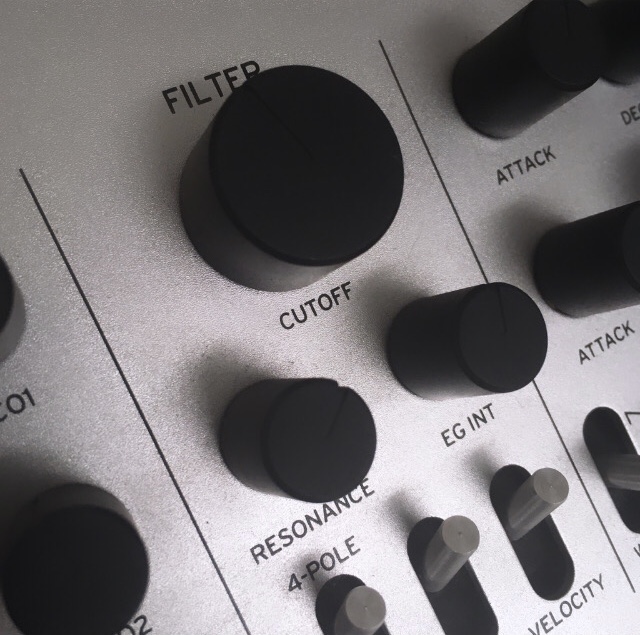
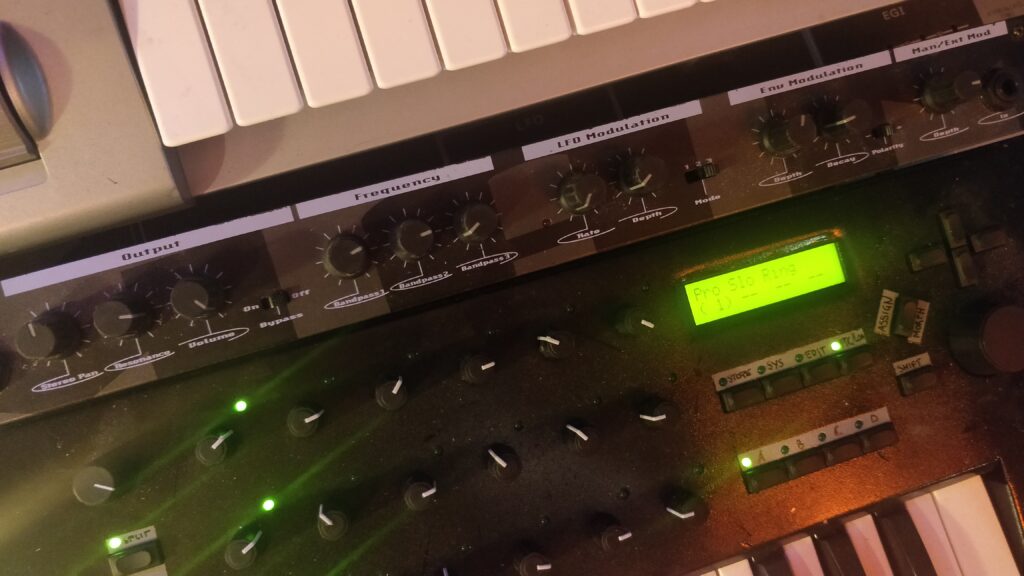
Korg Minilogue Filter/Resonance/EG Knobs. Being that this is my only piece of gear that has knobs, I am more than satisfied with the sounds that can be achieved. The possibilities are infinite. I look forward to purchasing knobs in the future and creating my own modular synth unit. I recommend the Korg Minilogue as a great start for anyone interested in enriching their sounds.
Filter Cutoff Korg Minilogue
2. Do you have an ‘almost’ perfect bit of kit? What would you change?
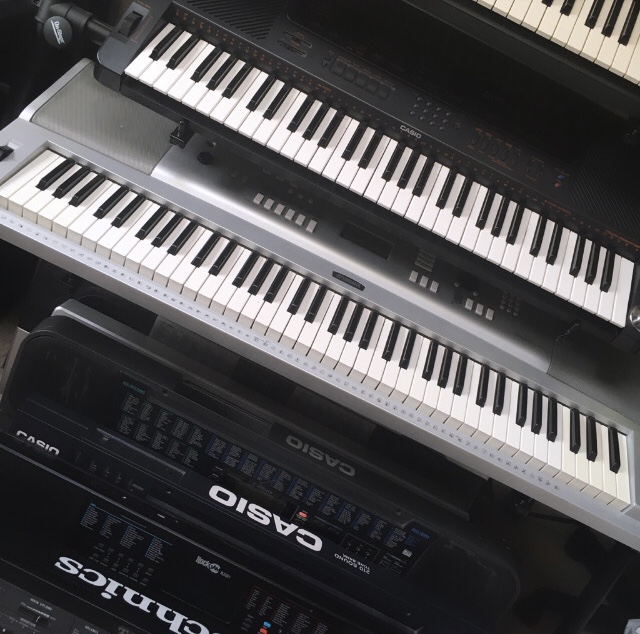
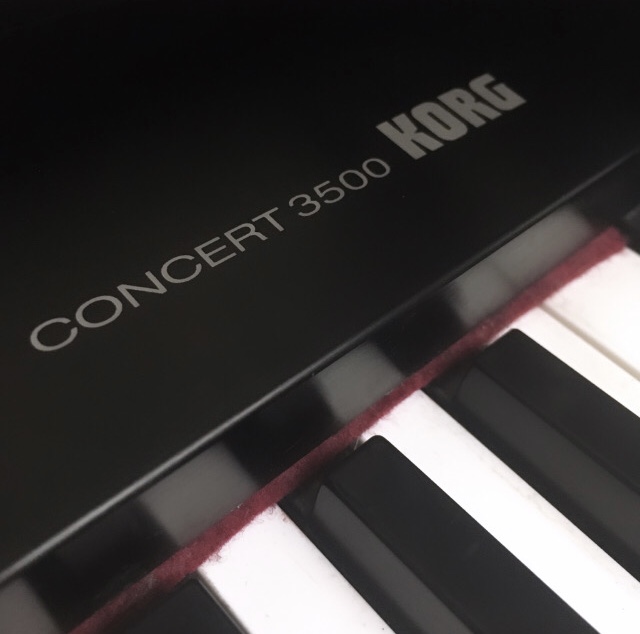
Korg Concert 3500. At the moment I am building my studio so all my equipment has a unique use for now. Unfortunately the sound quality of this vintage piece is of poor condition and needs heavy repair.
3. What setup do you bring on holiday/tour/commute etc.?
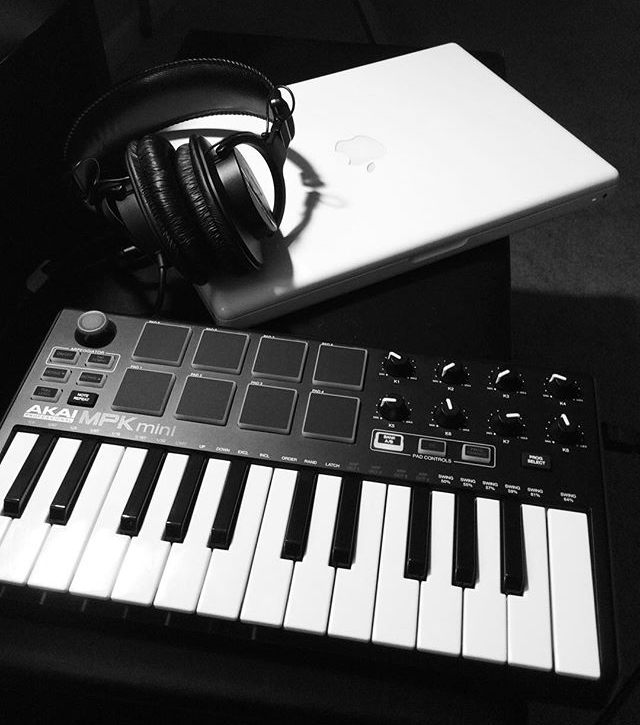
Akai MPK Mini
Laptop/Akai MPK Mini/Casio MT-240. For travel sake the Akai MPK Mini and the Casio MT-240. Both are lightweight and when combined, provide the essentials needed for recording ideas outside the studio. I have yet to perform and personally prefer making sounds as a therapeutic outlet.
4. What software do you wish was hardware and vice versa?
Garage Band is the only software I have been working with and it’s running a very old version of the program which I am not complaining about.
5. Is there anything you regret selling… or regret buying?
I could eventually regret all the cheap gear I am purchasing right now. Most likely I will hand it off to someone starting their own set-up. I personally don’t regret my buys because I learn from them. I have not sold anything at the moment.
Keys galore
6. What gear has inspired you to produce the most music?
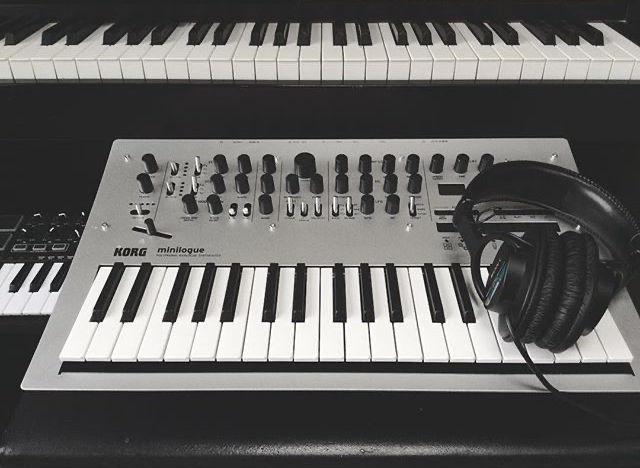
Korg Minilogue. This is my first and only expensive piece of gear as of now. Most of my equipment has been collected and repaired.
Korg Minilogue
7. If you had to start over, what would you get first?
A new laptop. I still need to buy one with better music software that doesn’t run at a glacial speed. It’s been a challenge but I’m surprised at what I have produced.
8. What’s the most annoying piece of gear you have, that you just can’t live without?
My damaged Korg Concert 3500.
Korg Concert 3500
9. Most surprising tip/trick/technique that you’ve discovered about a bit of kit?
All my cheap equipment surprises me if used properly. It’s not the gear it’s the artist.
Artist or Band name?
ARC Ambient
Genre?
Ambient/Dark Ambient/Other
Ashely Cronon
Where are you from?
California
How did you get into music?
I’ve been a band nerd since 3rd grade.
What still drives you to make music?
MUSIC
How do you most often start a new track?
It’s a therapeutic process for me so it depends on my mood.
How do you know when a track is finished?
I make short samples. I tend to let the tracks sit for a while and open them back up with fresh ears.
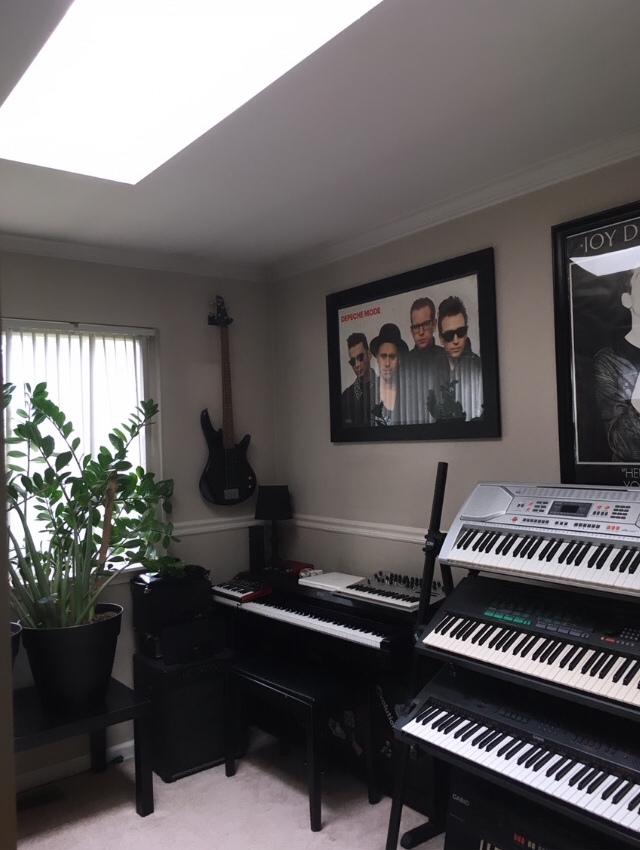
Show us your current studio
ARC Ambient Studio
Best creative advice that you’ve ever heard?
I don’t like to waste notes not even one – Johnny Marr.
Promote your latest thing… Go ahead, throw us a link.
1. Favourite knob/fader/switch on a piece of gear and why?
LSDJ and friends
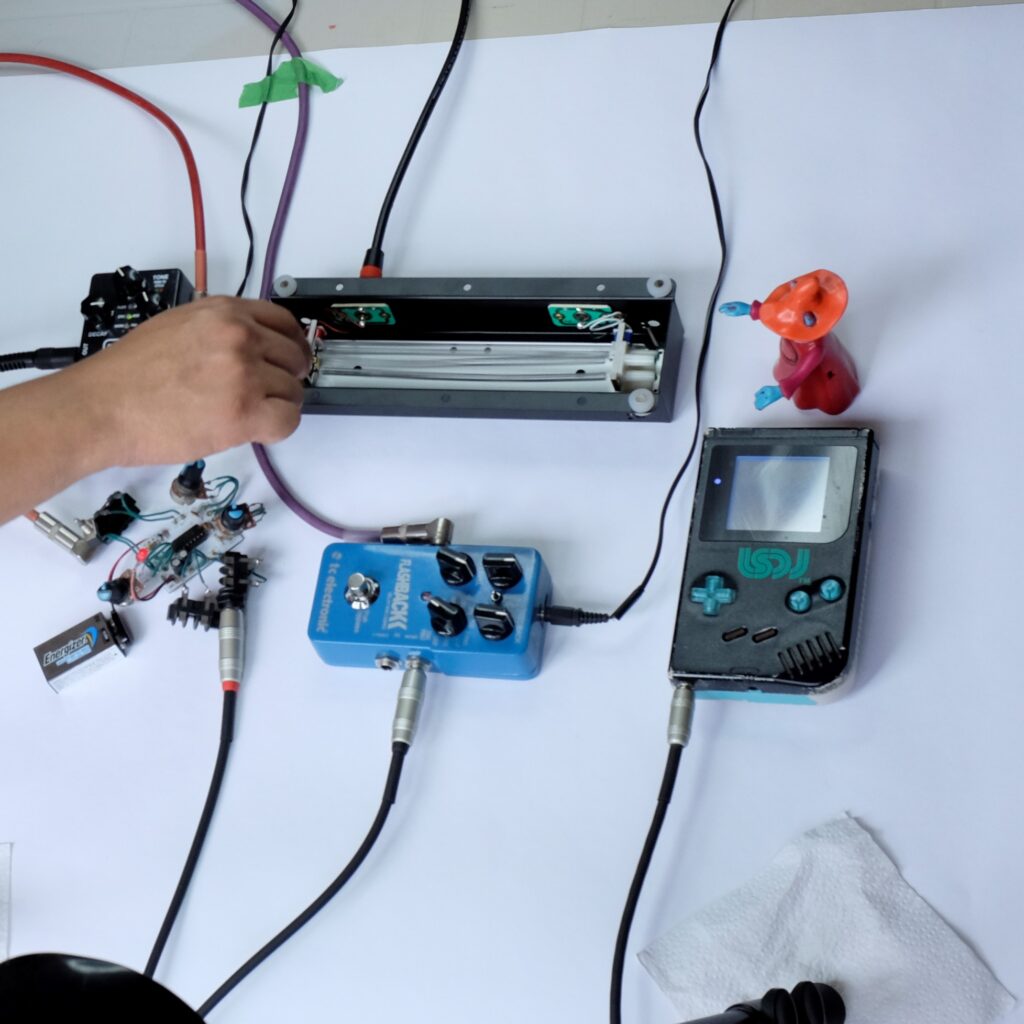
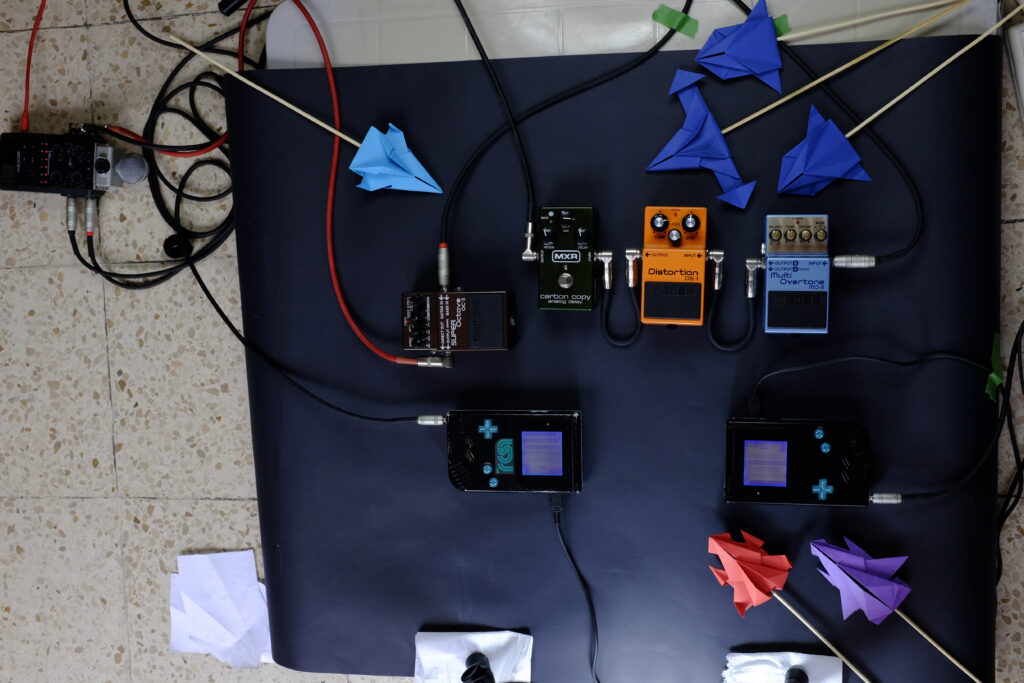
The election of the music gear depends on the emotion feels, desires to learn new music vocabularies or the song itself ask you the tools to create it, but the DMG-01 (any Game Boy model, with LSDJ and other music rooms) is one of my favorite music instruments, because is probably the best example that making music is a game and working with this tool is so fun. You know, you can made the DMG-01 a synth, sequencer, drum machine and MIDI controler; all in one, is fantastic. When you compose music with DMG-01 the form to see the complete music enviromment and aproach the ideas conditions the results, and let you explore unique options, wich would be impossible to conceive with other kinds of music tools; mantra: “one thing is with a guitar and another with a violin”; new mantra, “one thing is with a traditional synth and another with DMG-01”. Another favorite tool to ordering sounds is the Speak & Spell, it´s very rock, and the tape machines are pure magnetism.
2. Do you have an ‘almost’ perfect bit of kit? What would you change?
Another nice odd question my friend. I think if that chaos or randoms sounds are incorporated in all music tools, we could see the extra layers of the marble to create a better scupture. Sometimes we can control and generate our own chaos and random ideas, it´s part of the creative drift, but if we had the option to turn on and off an alternative chaos to compose is that what would change everything.
Light and layers
Optimize the creative cables. We all need the chaos, it´s like an angry ocean, you know, removes sediments, and create opportunities to see new forms of musical life. Imagine a random 5th channel on LSDJ; or more crazy also, like an extra random rope in the guitar, piano, violin, etc., to change its pitch without our being able to prevent it; composing assuming that randomness would be a good exercise.
3. What setup do you bring on holiday/tour/commute etc.?
Game Boy DMG-01 of course (it takes up little space in the suitcase) and a Zoom H6N or H4N. Sometimes I carry my guitar, but a paper and pencil are always the best tools.
Zoom recorder. Boss Pedals and GameBoys running LSDJ
Now, let me ask you a similar question.
What setup would you like to carry on a vacation to Mars or Space Station?
And imagine that there is a weight limit per passenger… perhaps Carl Sagan could advise us better at that time.
[Editor: I’d bring a tank of oxygen, it’s great for making sounds and it’s my absolute favouritefor breathing. 🙂 Throw us an answers in the comments below]
4. What software do you wish was hardware and vice versa?
Reason´s Subtractor Synth please! But I´d be very happy with all Propellerhead Software hardware racks, and I would like to have a Circuit Bending software, but one in which you can add and also buy toys to short-circuit them, just imagine, go to the library and select a Speak and Spell as a base, and have the possibility of hacking it virtually, for example: add controls for pitch, loops, hold, glitch, CV ports, LFO’s, etc.,
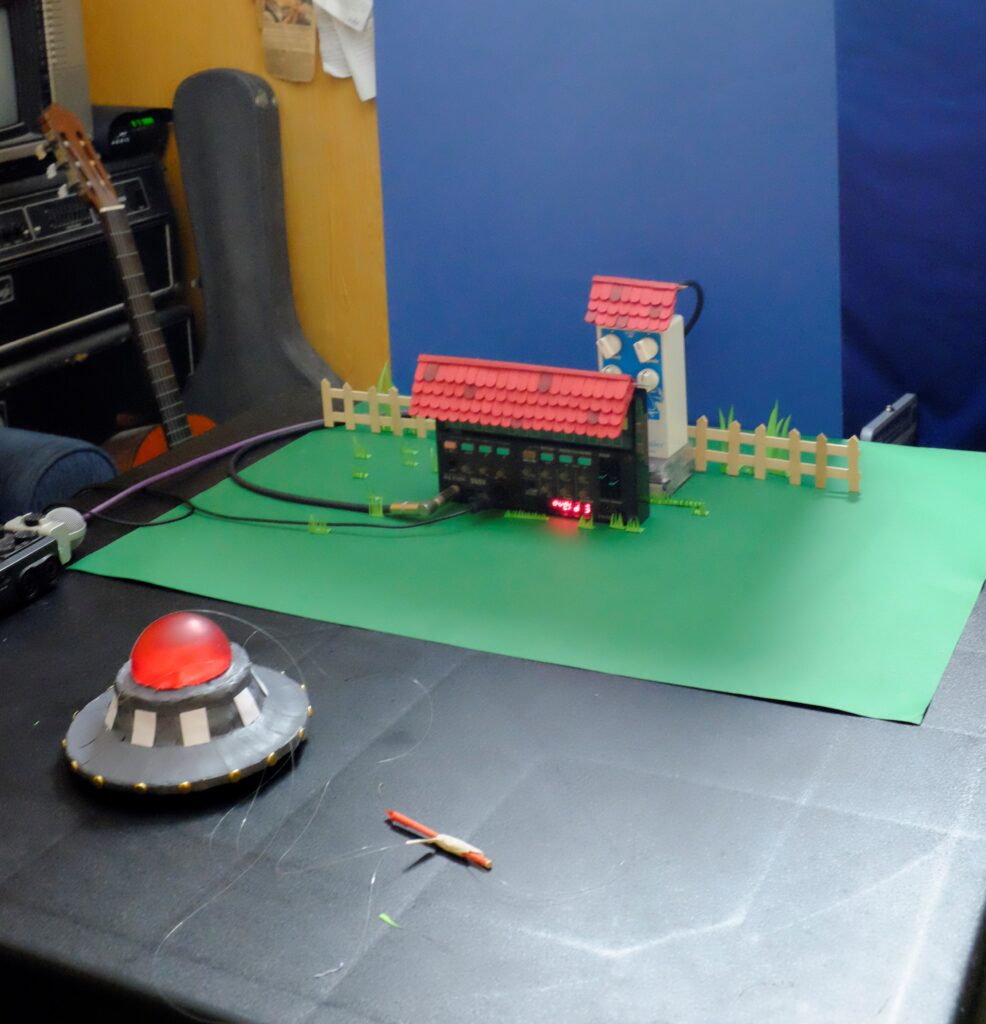
Korg Volca FM. Earthquaker Devices Dispatch Master and saucer
5. Is there anything you regret selling… or regret buying?
Yes, a wrong Mabuchi engine. I bought 2 of those motors to hack the Tascam Porta 03 and due to an inattention I bought the same motor model. Also I bought a TI-82 calculator and it still fills its main functions: addition, subtraction, multiplication and division.
6. What gear has inspired you to produce the most music?
Nice question my friend, and answer is: the Reason from Propellerhead Software, my guitar of course and the LSDJ. Most of my compositions start from any part of this trinity. Sometimes I imagine a melody playing a synth from Reason and continue it on LSDJ and other times I start something on LSDJ and take it to Reason, and my guitar is always there to solve any musical puzzle that comes up and initiate other ideas.
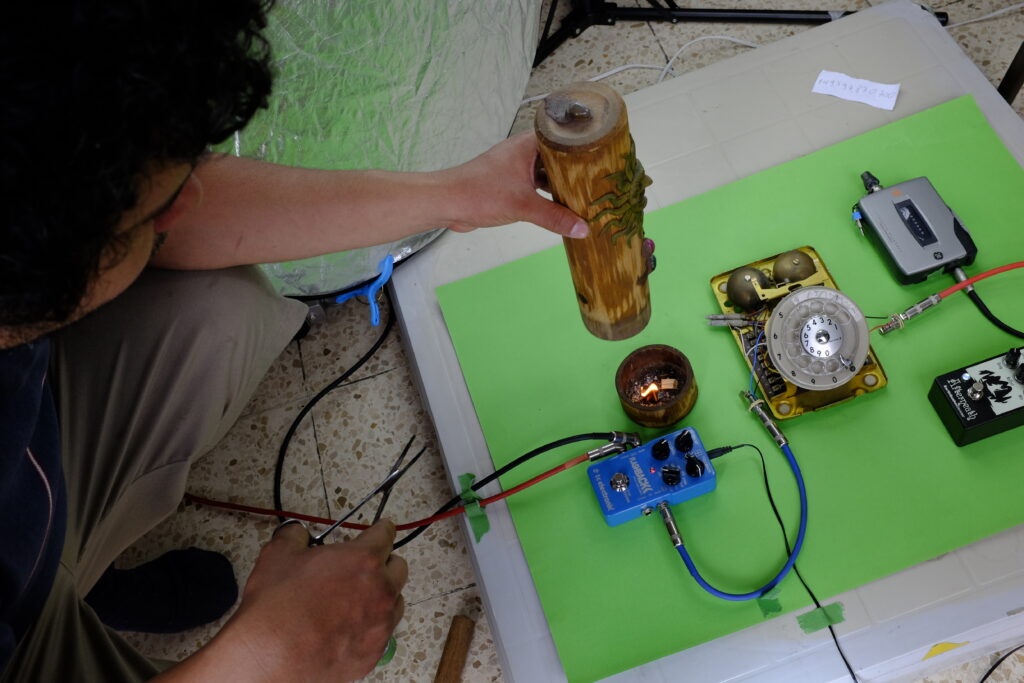
Sound as rituals
7. If you had to start over, what would you get first?
Tesla and Space X Stock when those companies started too; to be able to by more synths and audio equipment, but I wouldn’t change the order of things with which I started making music: my guitar, and actually, I have the desire to buy a drum set since my childhood.
8. What’s the most annoying piece of gear you have, that you just can’t live without?
TI-83 Calculator! It’s so heavy to use them with the Houston Tracker, sometimes I hate it, don’t get me wrong, because when I can make it sound, the bass lines sound so powerful, and I find it crazy to be able to make music with a calculator and place notes with sine and osine, but maybe I do several things wrong because I cannot turn off the calculator once I use them and I have to do the entire Houston Tracker installation process and when I compose something I have to take photos of the screen as a backup and breathe very deeply if unexpectedly it crash, but that “little calculating bug” produces good sounds and I would live very sad if I did not have my TI-83, I would even miss my TI-82 to which I still cannot install the Houston Tracker; somebody help me with that!
9. Most surprising tip/trick/technique that you’ve discovered about a bit of kit?
Synth Rotek’s Atari Punk tunes very well, it is unstable, but with patience it can sound very powerful. Atari Punk in general are valuable wildcards to create and express emotions, when I connect any sound source in its CV ports, like a DMG-01, sounds really fat, on fire!.
If you connect the Atari Punk to an arpeggiator or fuzz pedal, you can rock out for a long time, and with long reverbs they can sound like trival songs. Another trick is to rock the DMG-01. Using an overtone pedal and a distortion, you can get really crazy sounds! Sometimes it’s great to do power chords: two channels sounding at the same time, the first channel does the tonic and the second channel the fifth, but, to this channel different values are applied with the D (delay) command to each note, then you can spice it up with individual wrappers per instrument, put values in with the K (stop) command and Vualá, it sounds so close to a guitar.
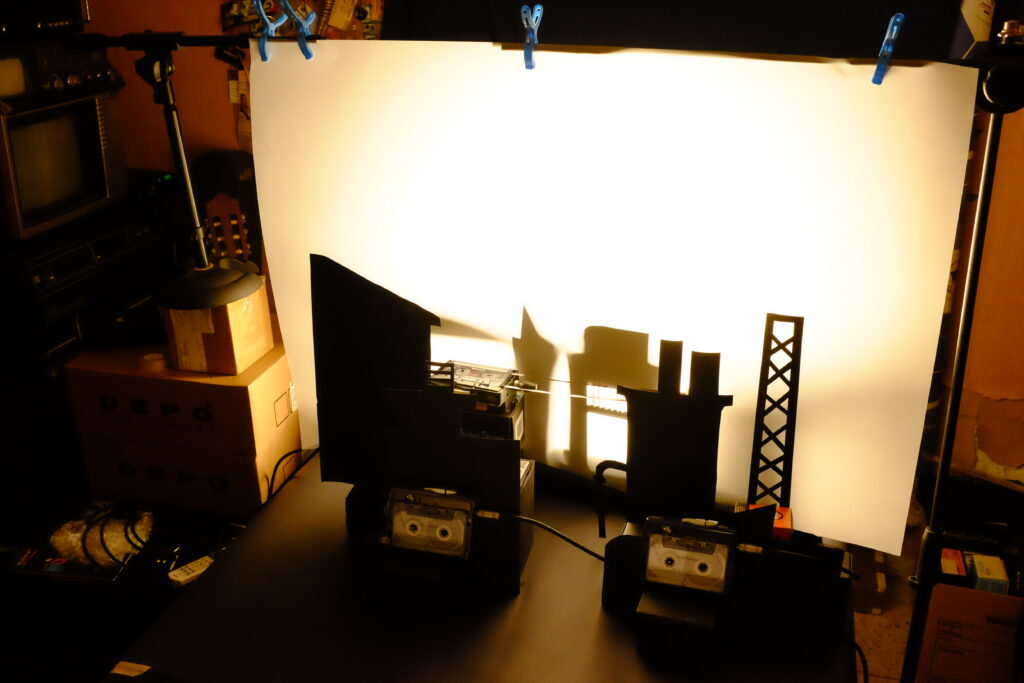
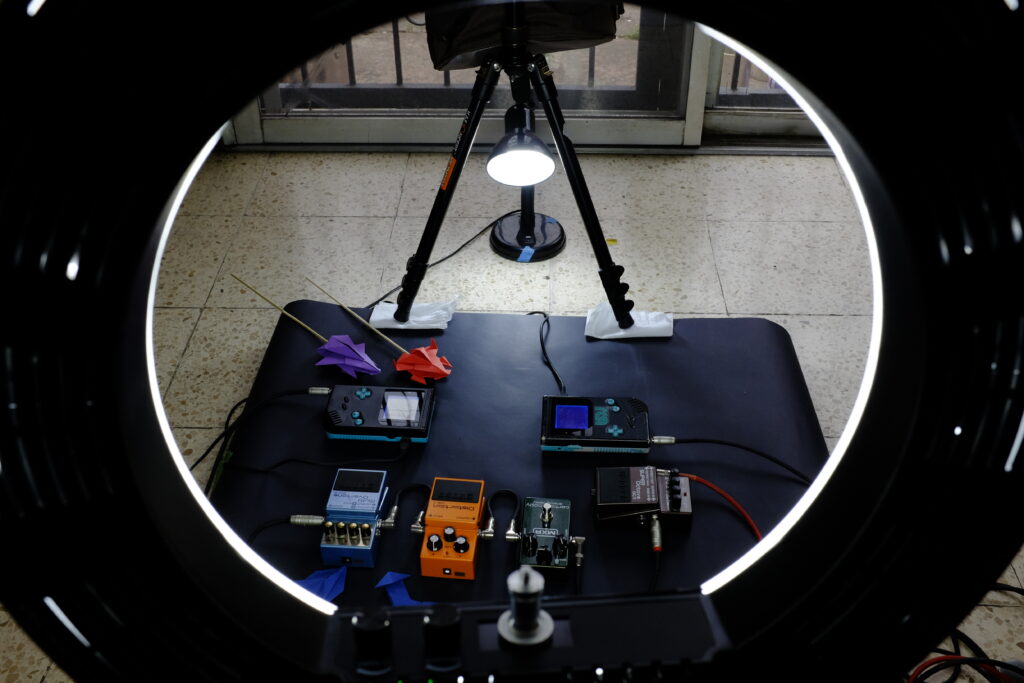
Through the porthole
Artist or Band name?
Droide Zen
Genre?
I’m going to paraphrase a great musician: Kevin Johansen “Soy un Desgenerado” (without musical genre).
Selfie?
Droid Zen
Where are you from?
Guyaquil – Ecuador
How did you get into music?
I honestly don’t remember an exact date, because I liked the music for as long as I can remember, music is part of my biology.
What still drives you to make music?
Breathe.
How do you most often start a new track?
Again, breathe and feel peace by my limbic system, And have the fortune to see an idea that excites me. Jorge Drexler in an interview said that making music is like a hunting ground, with different entrance doors, where you enter to hunt the same, but through different doors. The song that starts from the text, a sequence of chords, a melody, noise or random proceses is different.
How do you know when a track is finished?
Perhaps intuition, you never know, maybe a track is never finished. Songs like that have only single chord have a life and their own and their own evolutionary path. The thermometer that I trust when I make music is the feeling, if the result transmits energy to me and when I add something the original emotion changes or that energy is lost, well, it’s time to stop and let the song breathe on its own, and listen to it after a long time and if it still retains the same feeling, it was always alive from the beginning.
Show us your current studio
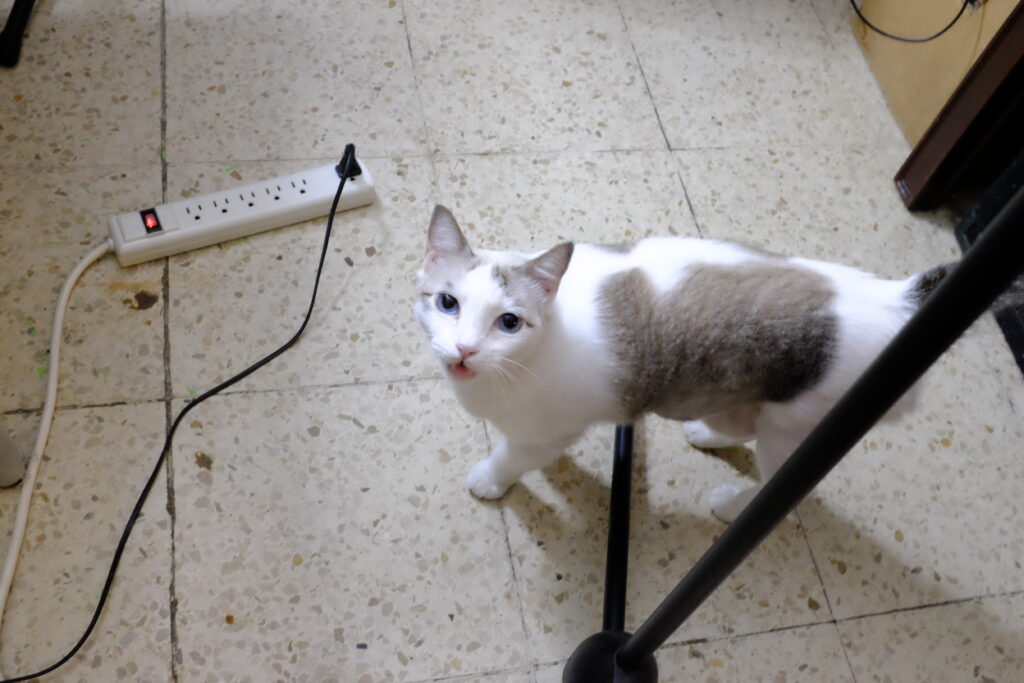
Studio cat
Best creative advice that you’ve ever heard?
A universal advice: live with the mistakes that we will make.
Another good advice is one that Leda Valladares gave to Pedro Aznar: feel the ancient cosmic, sing with the guts, without worrying so much about aesthetics, your song must be credible. In spanish you say: cantar desde las entrañas.
Promote your latest thing… Go ahead, throw us a link.
1. Favourite knob/fader/switch on a piece of gear and why?
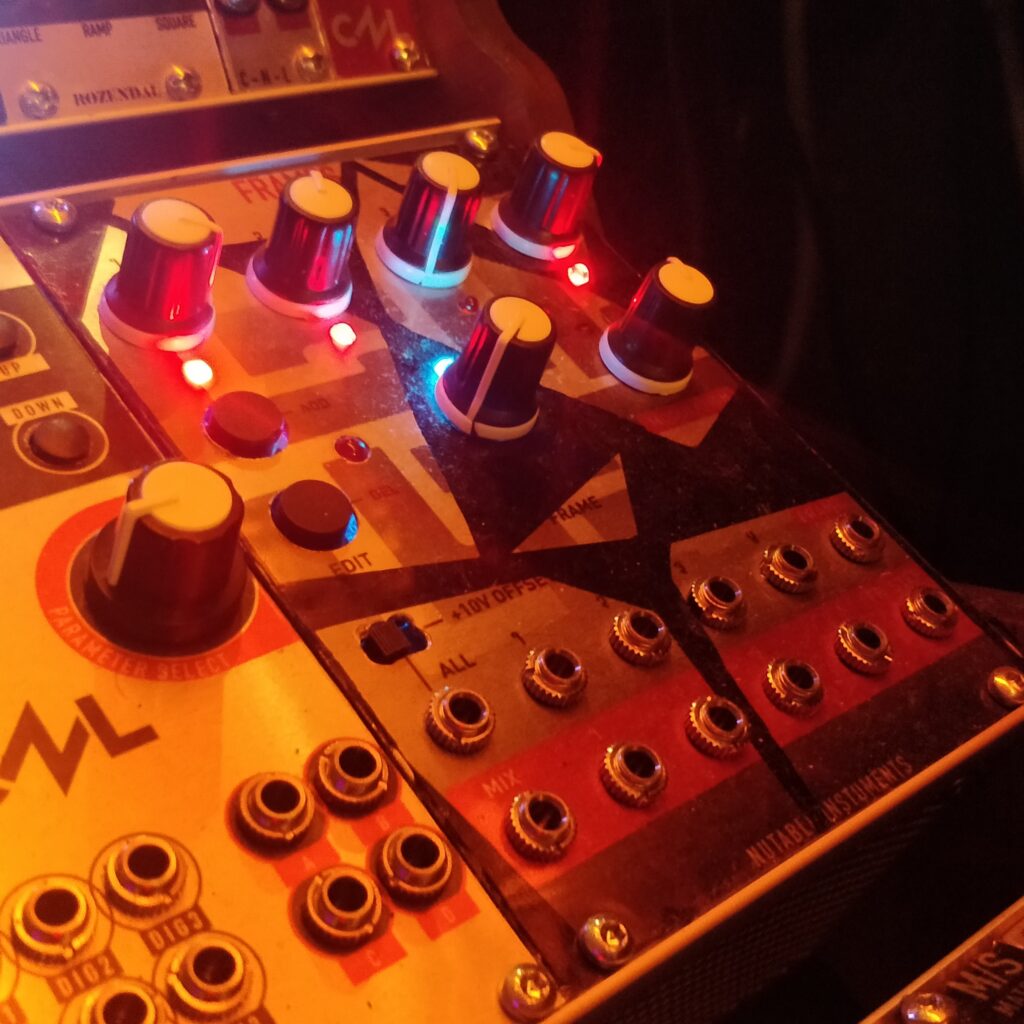
I could make this about feel or what it does to a certain sound, but I’ll answer it through another perspective. The knob that has meant most to me is the keyframe knob on mutable instruments frames module. This is going to be a long explanation, so please skip if you don’t like tech philosophical ramblings…
[Editor: Bring it!]
Keyframe knob on Mutable Instruments frames module
So what about that keyframe knob… In short, the idea is that you save settings to a chosen point of a knob and any position in between two saved states is outputting an interpolated value. But let me give you a long background of why I find this so revolutionary… I remember a late night in Stockholm (actually at a bachelor party for Daniel Araya of Araya Instruments ( https://araya.se/ )) where Jon of THC ( https://thehumancomparator.net/ ) started discussing alternative synth interfaces with me. I had made a semi-name for myself on different forums and through some explorations of alternative interfaces ( https://cdm.link/2010/11/alternative-musical-expression-a-diy-pressure-sensitive-multi-ribbon-controller/ ), so I guess that’s the reason he approached me. We talked for 45 minutes about the most minimal interface that could still expressive and fun to play. I don’t know if that discussion lead up to anything fruitfull for Jon or if it was lost in the alcohol fumes on a late summer-night. But it managed to keep me awake all night thinking about a box with a couple of buttons and one knob.
The concept I couldn’t stop thinking about was to wrap a kind of standard analog synth in a set of voltage controlled parameters with digital control and randomise sounds on a button click. The randomised sound could then be saved to the current position of the knob. After adding a few sounds to different positions of the knobs rotation – turning the knob would then interpolate all parameters in between the saved positions.
Of course it had some other stuff to it in the discussed design, but the idea at its core, as described, is quite simple and was born out of my love of the patch mutator / randomiser in the Nord Modular G2, with kind of a twist of the morph groups on the same instrument. I got into eurorack clone building about the same time and found the keyframe knob in the frames module to be a fantastic, while limited, implementation of the same idea (though without randomisation).
The simple synthesizer was never built (I may still revisit the concept in the future as I still find it brilliant), but the idea of the keyframe knob has kept on hunting me. In the last couple of years my own eurorack construction is made by modules I design from scratch using kicad – and as anyone with a huge eurorack I have a certain jealousy on the Buchla 200e series. The patch saving is so neat and fun and the internal databus is simple and clever. I will however never spend that kind of money on an instrument… …and the implementations on it still leaves something to be wanted. So, where does that leave me?! What I have done myself is to replicate the code and the micro controller-based setup of the MI frames into my own modules with a central external control and 8 DAC channels and 8 VCAs on each module. I save settings on each module through a press of a button on the central control module via a databus and I send a voltage out on a CV-bus to each module of the current position. In that way I can control presets and interpolate between them in a theoretical infinite Modular system with one knob.
Right now I have 4 different module designs based around this architecture, but whenever I have time and ideas I’ll design some new ones… (Sorry, I won’t show any pictures or release any code or schematics as I can see a future commercial potential in this system) So how does it make me feel?! Well, the pleasure of sweeping and finding sweet spots in the interpolation is great, it opens up totally surprising movement to sounds. And as the frames, this parameter is voltage controlled, which means that simple sequencing of it creates the weirdest stuff ever… To finish up this infinite explanation… …the reason I picked the Knob on the frames, is that it keeps reminding me of the most clever innovative concept i personally have been implementing and using in a musical instrument. My story tries to put light on the wonderful synthesis of different concepts, born from different designers and how it can be used create something new.
2. Do you have an ‘almost’ perfect bit of kit? What would you change?
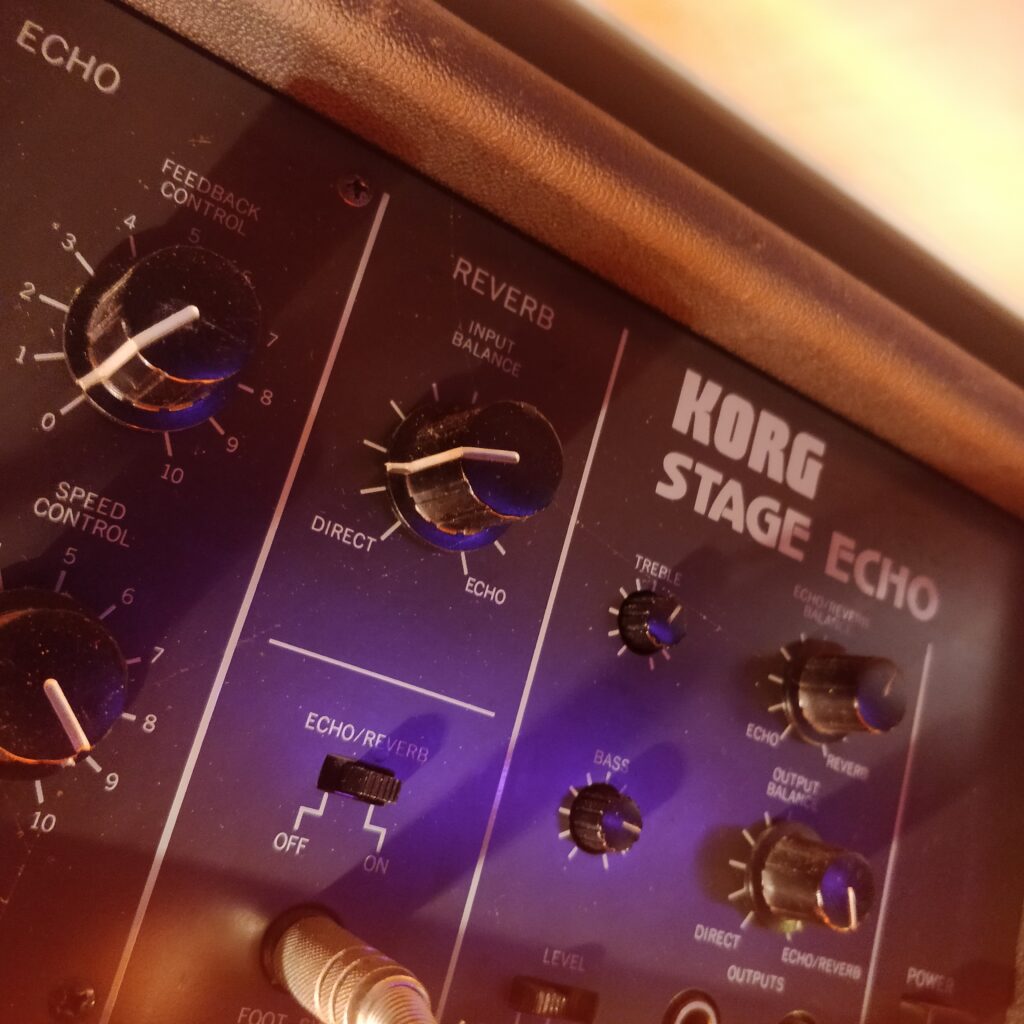
Korg Stage Echo SE-300
The Korg Stage Echo SE-300. It looks like a more serious brother of the Roland RE-301. The preamps has a great sound when overdriven, the tape delays has a really nice sound on self-oscillation and the spring reverb has a nice quality to it. I can put the spring reverb on just the delays if I want, but I can’t put it into the internal feedback of the delay – so if I want the delays to drown out more and more for every repetition I need to patch it up in creative ways. Having that possibility with a switch would make it perfect (I can feel a modding session coming up).
3. What setup do you bring on holiday/tour/commute etc.?
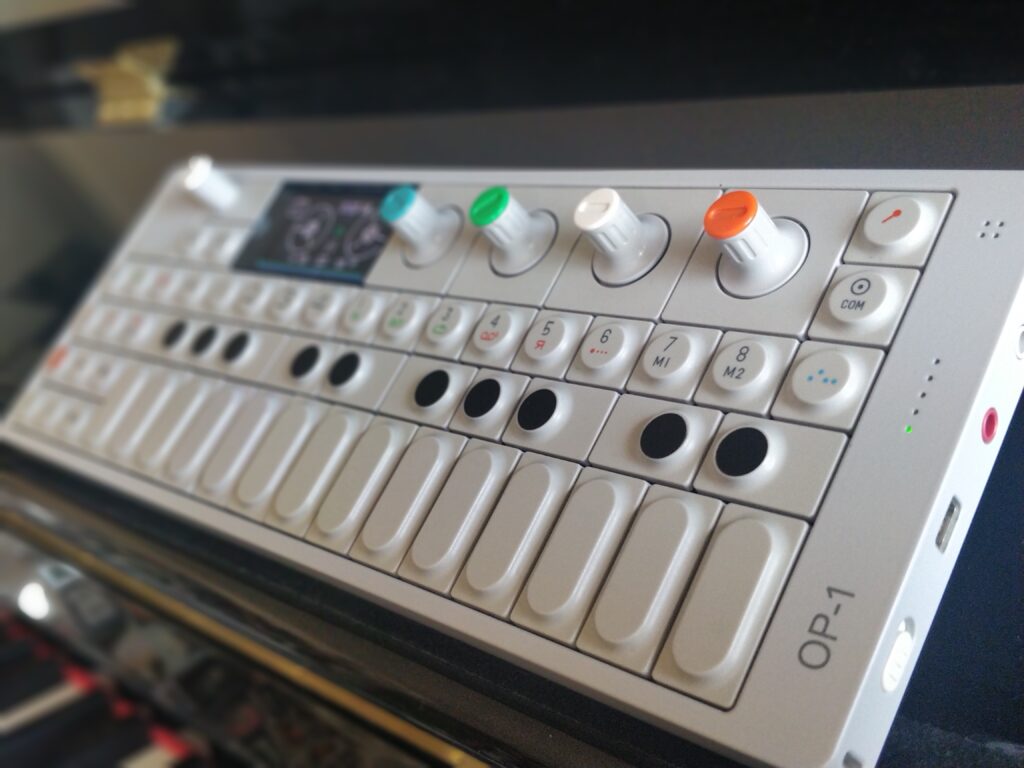
MacBook Pro, Arturia Keystep and Zoom h2n (well, at least this summer vacation, I usually bring the Teenage Engineering OP1 as it is smaller).
OP-1
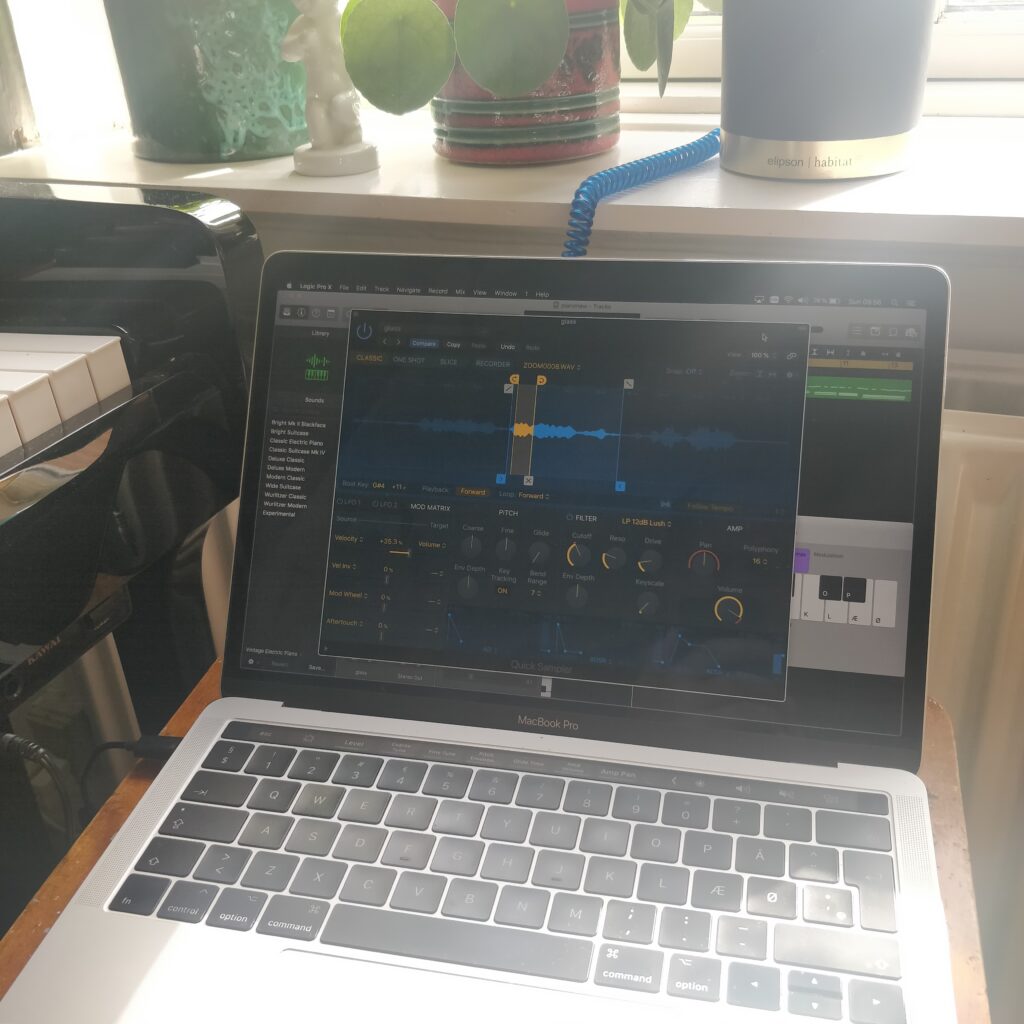
It was really nice – I went around recording weird sounds and used the new quick sampler in logic to create instruments from it. (This piece of software is brilliant, simple auto-looping and automatic tuning of the sample). It was a great way of expanding my personal sound library as well as learning the new stuff in the latest version of Logic.
Quicksampler in Logic
4. What software do you wish was hardware and vice versa?
I would love logic’s new quick sampler in a small hardware keyboard with a decent microphone running on batteries. If I hear a nice ringing sound of a garbage can, I could just sample it, automatically set looping points and tuning. And get something musical to play instantly. Like a OP1 but more usable…
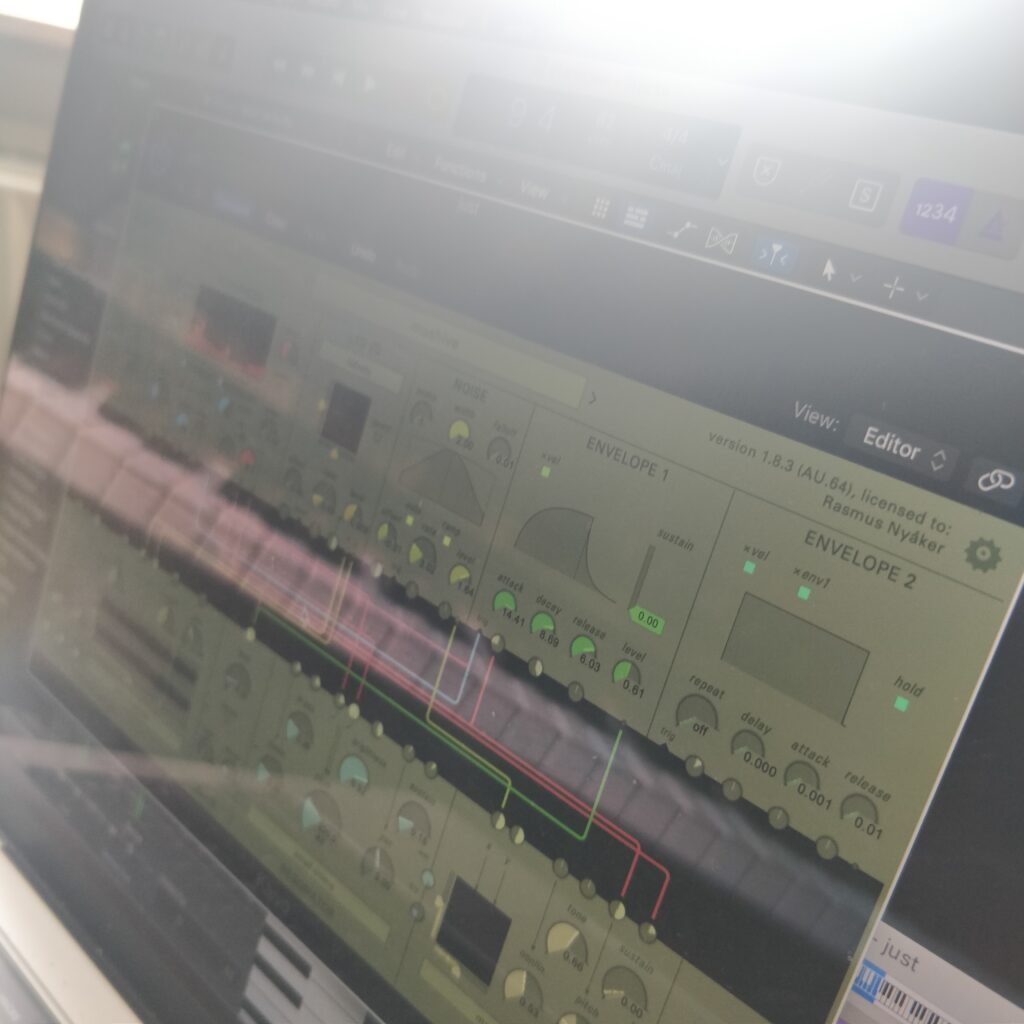
Kaivo VSTi
I would also love to have Madonna Labs Kaivo with physical controls and a 3 octave keybed (it would replace the Nord Modular G2 as my “sofa synth”).
Nord Modular G2
The other way around I would love the MAM RS3 resonator as a plugin, whatever I put through that machine comes out sounding sooo great, the overdrive in that circuit is really musically inspiring.
MAM RS3
5. Is there anything you regret selling… or regret buying?
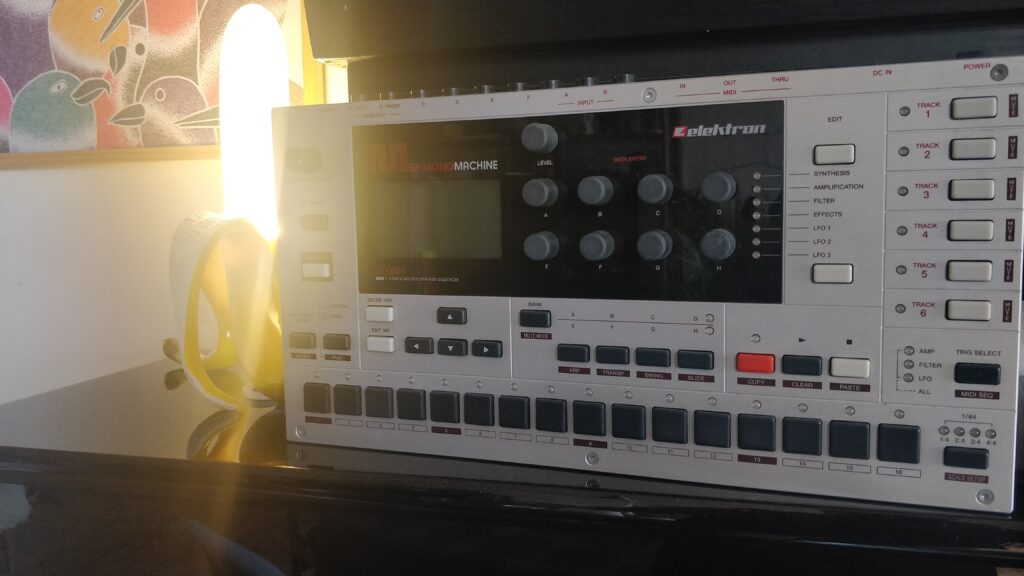
I have been through a phase of re-buying everything I’ve sold that I’ve missed. I’m on my third Monomachine, my third Machinedrum, my second Sherman filterbank, my second Xbase09 etc… So I don’t miss anything anymore, but I have and had stuff that I regret buying…
The Jomox Xbase09 for instance. I really love the sound of Jomox, but that interface and the choice of hardware, omg, I really hate using it. But for some reason I bought one again after selling it… The only thing worse is probably the Spectralis groovebox (also a great sounding machine). I traded my Machinedrum and Monomachine for it and got lots of gray hair plus resentment towards yet another synth-designer. Thank God I managed to trade it half a year later for a Machinedrum UW and a vintage small stone pedal (the Machinedrum left again… …but a few years ago I picked up another one at a price I couldn’t resist… )
Elektron Monomachine
6. What gear has inspired you to produce the most music?
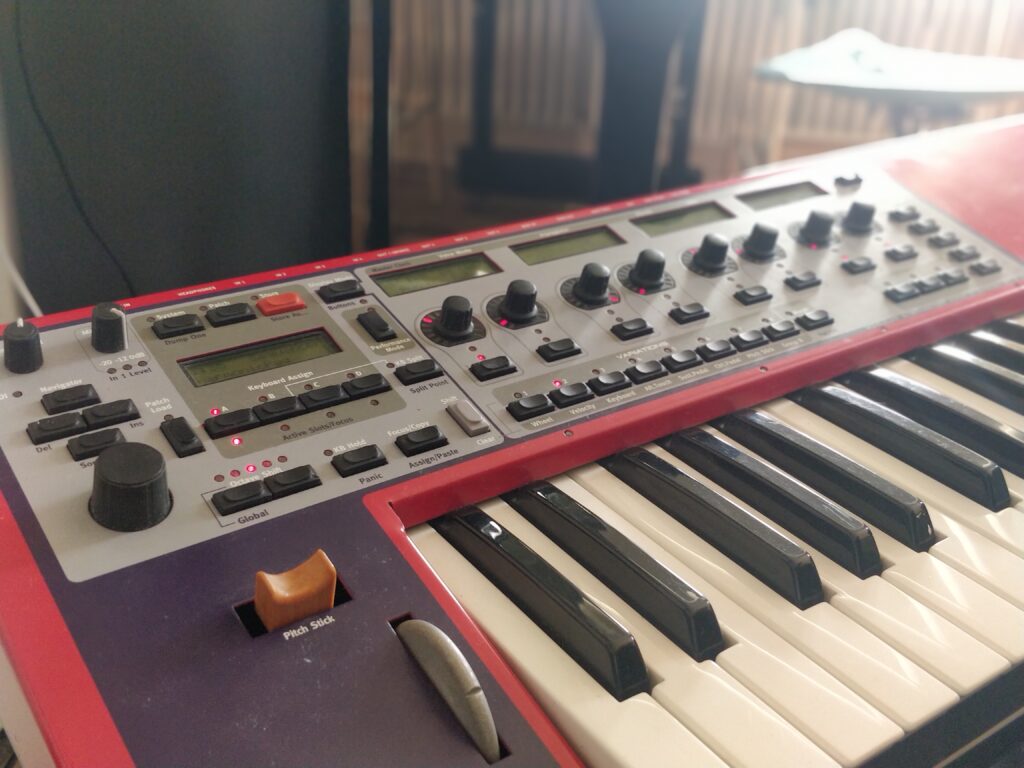
My Nord Modular G2 – I traded a shit-ton of synths for it. The idea I had was to focus almost solely on just one synth. I made patches everyday, learned lots about modular synthesis and produced music in my most prolific flow ever. ( an example of a track from that time where almost every sound is from the G2: https://www.youtube.com/watch?v=LOen47S0jco )
7. If you had to start over, what would you get first?
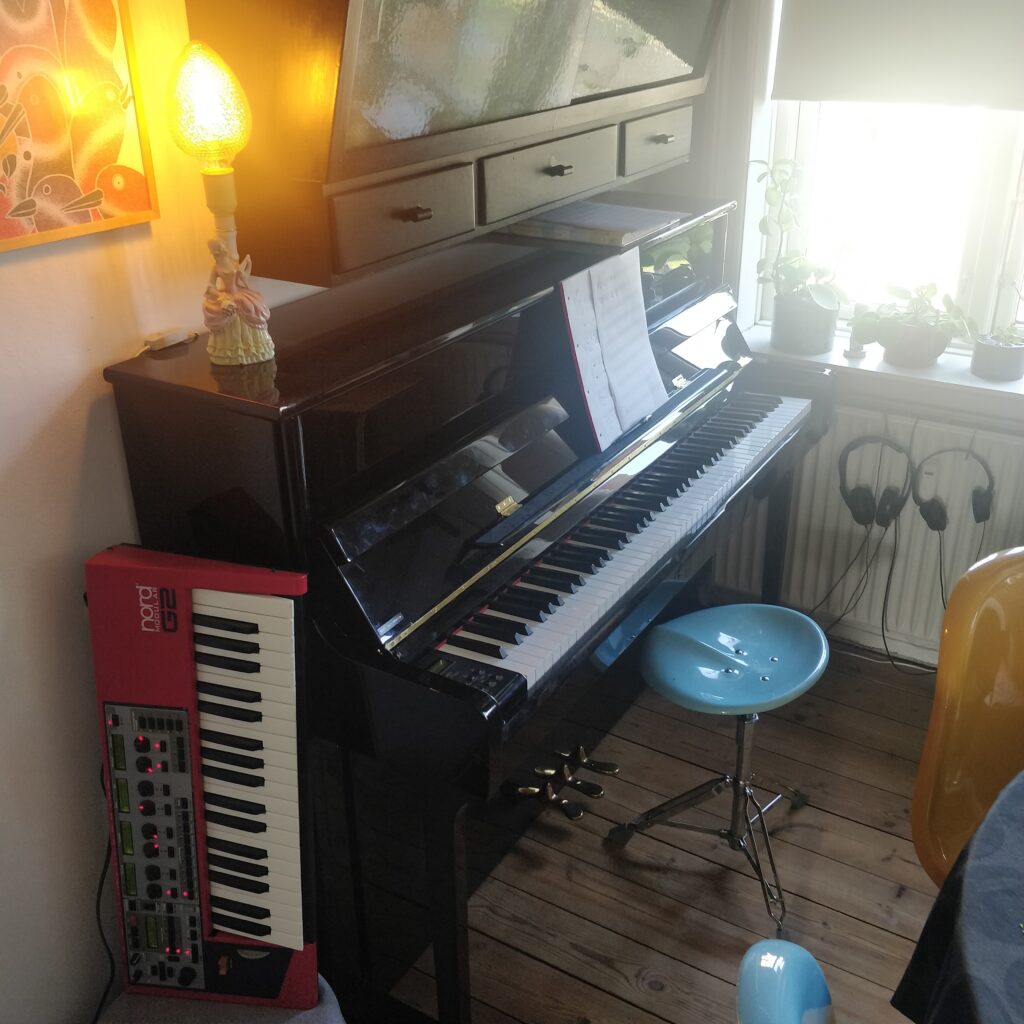
An acoustic piano (after wanting one for 25 years I finally got my self one of those fancy new ones where you also can play it digitally with headphones, and it has really been inspiring to play for an hour each day – I get more musical ideas written down than ever before in my life – and I actually feel that I get an improved musical sense every day)
Piano
8. What’s the most annoying piece of gear you have, that you just can’t live without?
Probably my DAW – Apple Logic. I find that DAWs are really old school in their setup – using piano-roll and analog mixing paradigms. I usually build stuff in a very Modular way using aux-channels, feedback and complex routing between effect plugins and the fact that these combinations can’t be saved as ‘racks’ to be inserted into other projects is really turning me off… I keep doing so much screen-patching over and over and I can’t manage to make templates that fits every way I want to go… But it is still the center of all music I make.
Little DAW, but lotta reading 🙂
9. Most surprising tip/trick/technique that you’ve discovered about a bit of kit?
Most of what I do in my studio today is based around combinations of effects and creative routing. A few simple units running parallel or in series with some feedback can create the most imaginative soundscapes… For me this started when I bought a Boss SL20 slicer pedal 10 years ago – it was kind of a one-trick-pony and not that interesting… …until.. I put it after a reverb. It created all this pulsating harmonic rhythms from even simple piano playing ( I have an example of the first track I made with it and the reverb: https://www.youtube.com/watch?v=_MZpNx41Ugc ). This kind of combination has kind of been my sound since and a thing I keep coming back too, sliced reverbs in different forms… I eventually sold the pedal and replaced it with (3x) Boss VF-1 which also contains that slicer effect.
Lotta synth, but a little guitar too
Artist or Band name?
FEJLD / The Mush Orchestra / Copenhagen Noise Lab
Genre?
Usually ambient or other electronica not centered around rhythms
Selfie?
Cph Mush himself
Where are you from?
I am an exile swede living in Denmark since 2010.
How did you get into music?
My father was a musician, that helped my early gear acquisition phase, but I think that I got into music making cause I was inspired by some older kids. I was shown a tb-303, a tr-909, a tr-808 and lots of other techno machines by these kids in 1993. They made sounds I had never heard before and I got obsessed. A few months later, just after my 13th birthday I went to the local music store and bought my first synth – a Korg MS10. That was the start of my identity and the sound of the 303 became the soundtrack of my teenage years.
What still drives you to make music?
I am not really a musician or a producer. But I believe that the need to create is an essential part of my being. I used to write music to have a diary in a sense, to help me remember my life. Nowadays I don’t need it in that way anymore – but I need to create, whether it is designing circuits, building furniture or composing music, I can’t breathe without it. I do however feel no strong need though to share the stuff I do. Sitting in the studio, patching up a rhythmic drone on a Modular and playing some improvised piano hook on top is as least as rewarding to me as making a finished piece of music. I enjoy the creative process. The place where the mind is focused and absorbed by a creative task is the main place to be for me.
[Editor: Amen to that]
How do you most often start a new track?
I usually sit down with a machine or a module trying to learn how to use it better (I have way too many instruments). Usually I find something interesting that I feel the need to record. And once I have recorded it, I’m kind of in a flow and I start recording improvisations on other instruments over it. …I never learn to use the stuff in better ways as I kind of gets lost into the flow of music production…
How do you know when a track is finished?
This is an interesting question. Mainly because it highlights how little recorded music has evolved as a concept during the century it’s been around… Let me explain…
My work is as a chief of a technical development department. If we release some software we can be sure it won’t be the final version, we expand functionality, we fix stuff and keep working on it after it has been released. Music is now a digitally distributed product, just like the software mentioned, but it is supposedly done/perfect once it has hit Spotify/Bandcamp/SoundCloud/whatever. Films suffer a bit on under the same failure to adapt – but with platforms like Netflix/HBO/etc. we are beginning to witness some change. It would be lovely to see more experiments that highlights the great part about this digital distribution system for music…
So, how do I know when I’m finished? When I make tracks I try to finish them up before I need to go to bed, so I can start from scratch next time I get inspired, if I don’t finish it before bed I will probably never finish it. (With my piano however I keep writing and rewriting the score sheets for weeks – I haven’t recorded anything written with it yet though)
[Editor: Perhaps music has unnecessarily, become an artform like scuplture or architecture. Where the final product is static and unchanging. This could easily change with generative or ‘interpreted score’ based music and digital distribution via programmable interfaces. Perhaps a bit like Brian Eno does with his music apps?Where we basically see the role of composer and listener become more and more blended together]
Show us your current studio
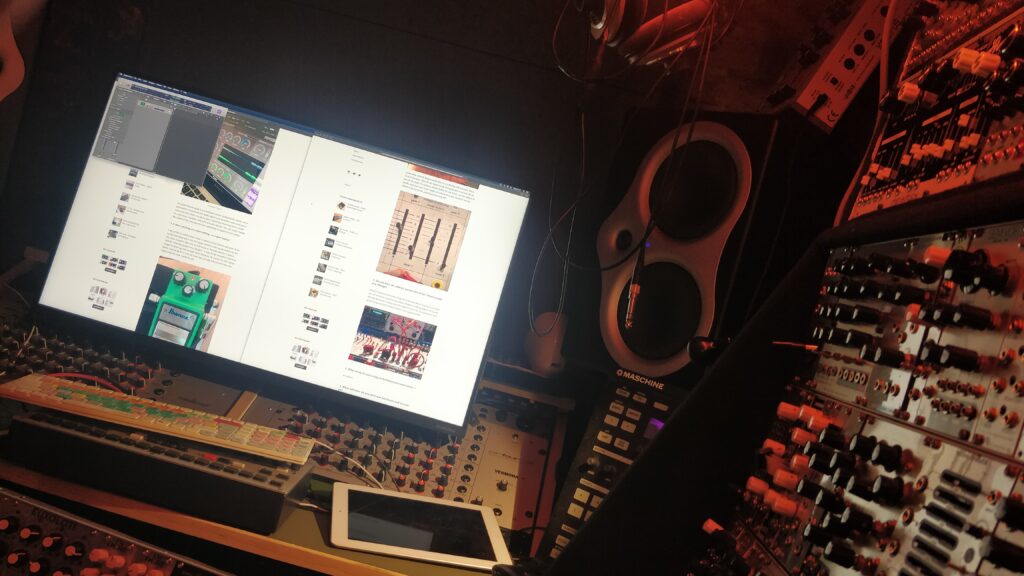
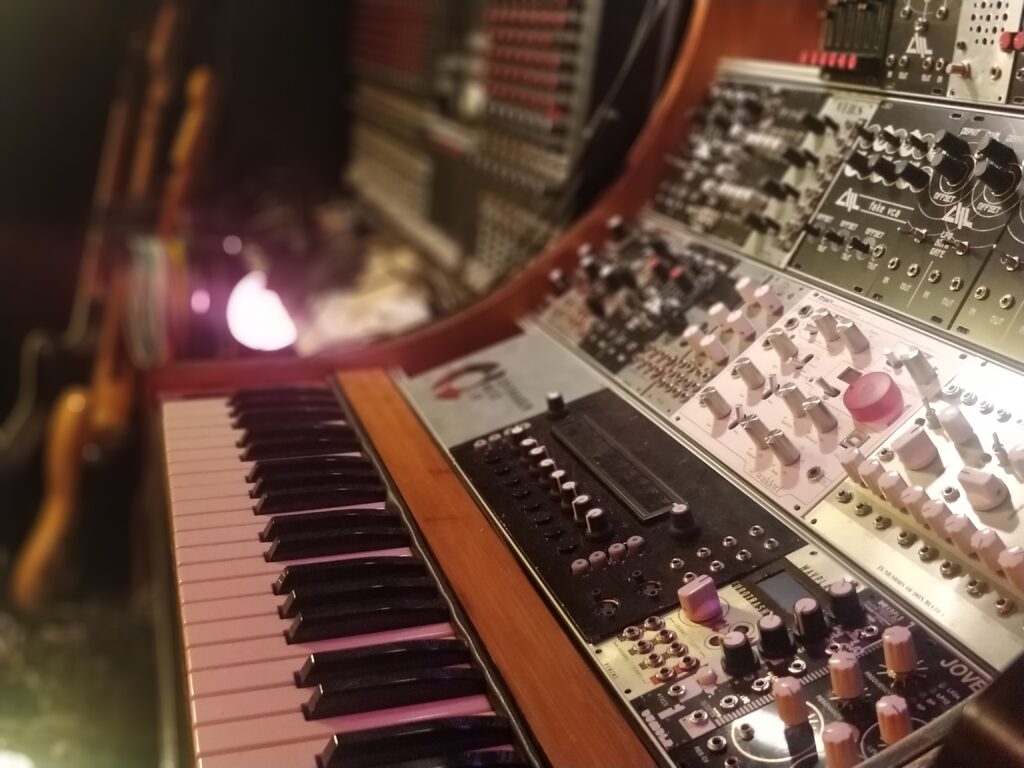
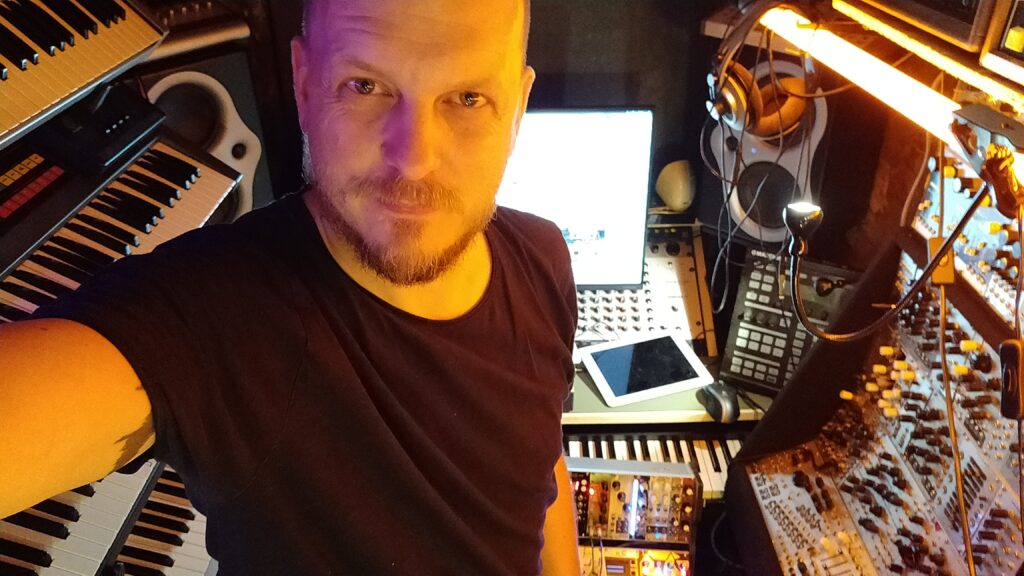
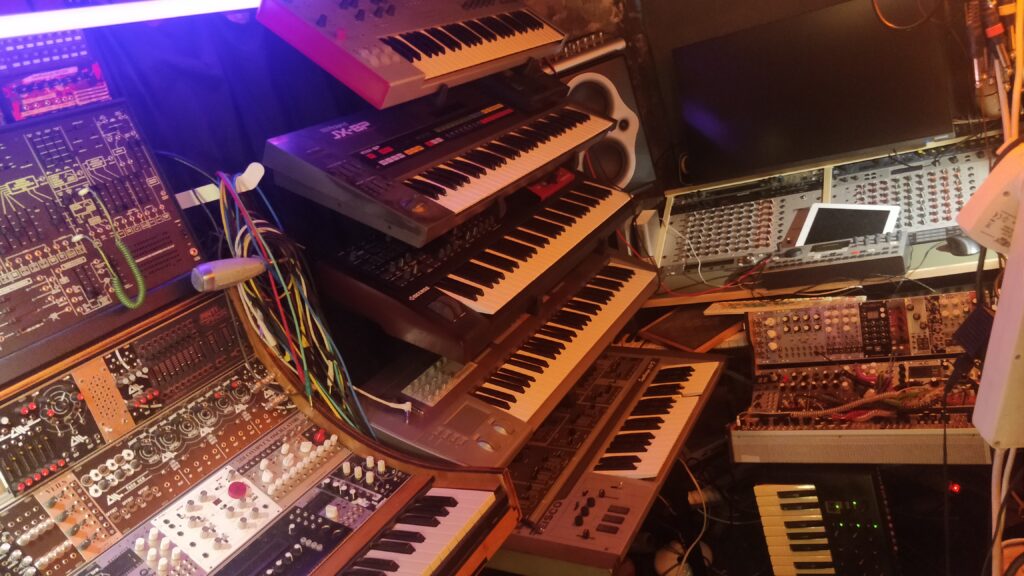
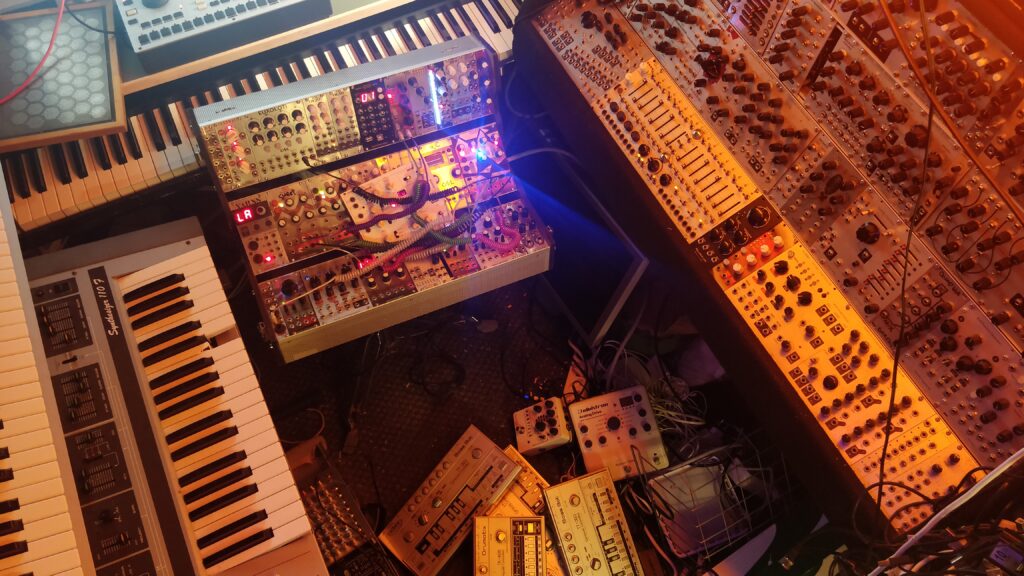
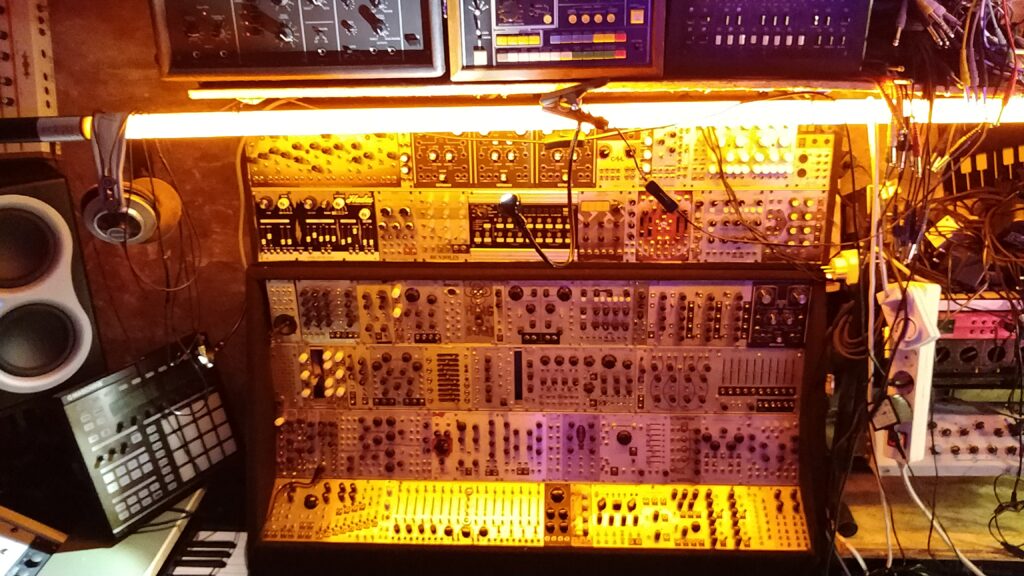
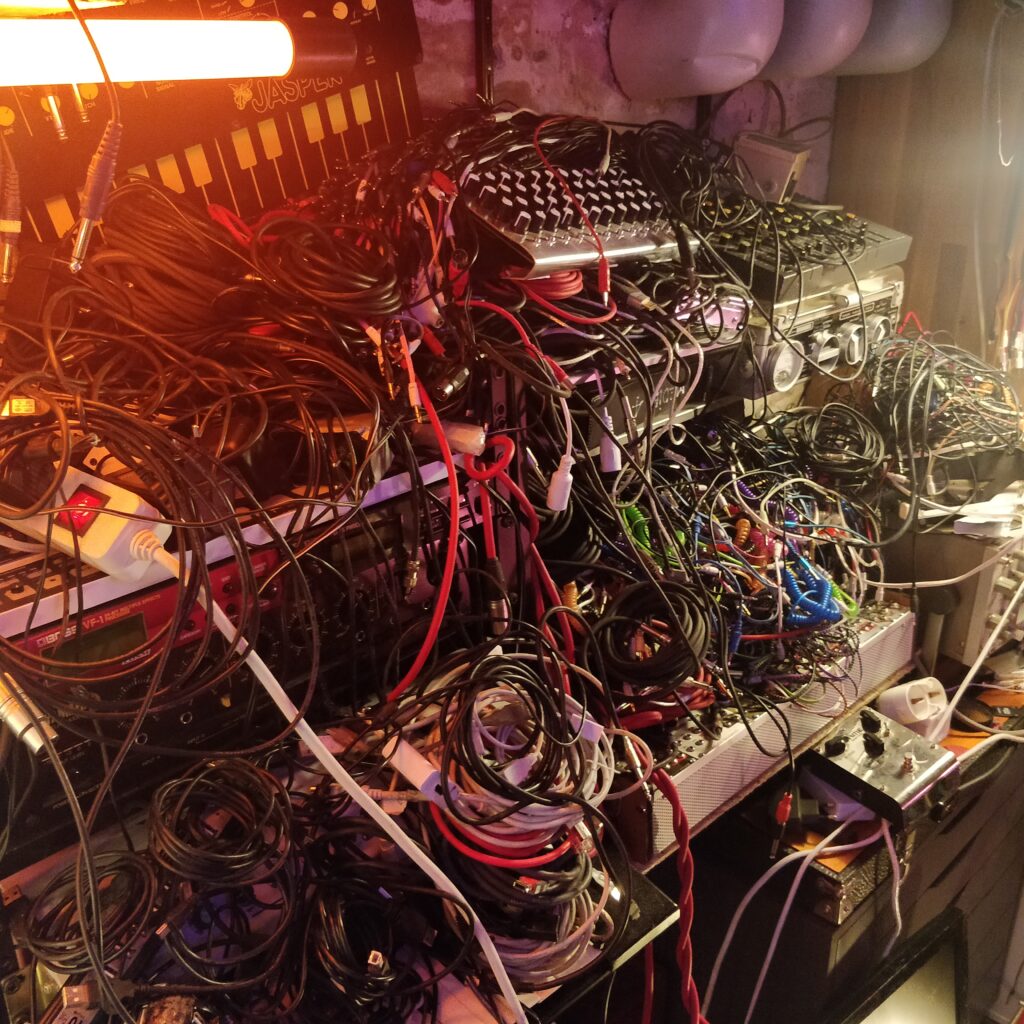
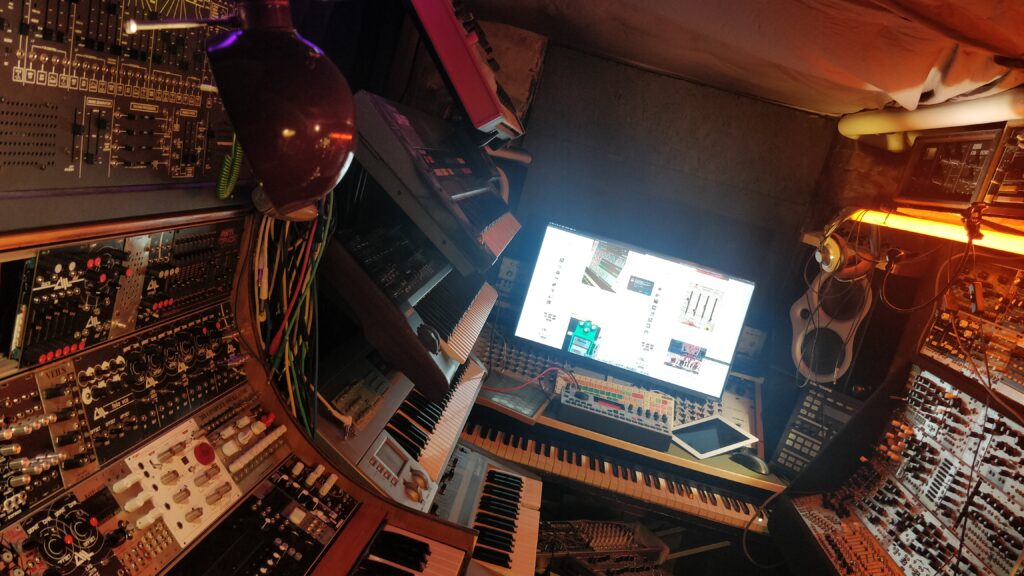
Cph Mush synthsCph Mush studio from aboveCph Mush Mega ModularCph Mush spaghettiThe CPH Mush Synth Cave
Best creative advice that you’ve ever heard?
Be creative with whatever you have around. Great art is created from great ideas, not from having the latest gear. The perfect tool is not important. (I know… Kind of weird thing to promote on a gear-centric blog)
[Editor: Yes its weird, but also thought provoking!]
Promote your latest thing… Go ahead, throw us a link.
I don’t share much of what I do nowadays, but checkout my Instagram ( https://www.instagram.com/cphmush/ ) and don’t be a stranger if you want to have a philosophical discussion about the future of musical instrument interfaces. 😉
[Editor: Do you have a favorite tip, trick or way of working with any of the gear from this interview? Then throw a comment below…]