Shawn Jimmerson – Nice Noise Blaster

1. Favourite knob/fader/switch on a piece of gear and why?
Tasty Chips GR-1

I recently acquired a Tasty Chips GR-1 granular synthesizer for the very reasons that it is standalone, has tactile controls, and great visual feedback. I was at Perfect Circuit here in the Los Angeles area checking out a bunch of new synths and couldn’t stop playing with the GR-1. I fell in love with it. The fader that moves the playhead across the sample is extremely satisfying to use and is a current favourite.

Some others worth mentioning are:
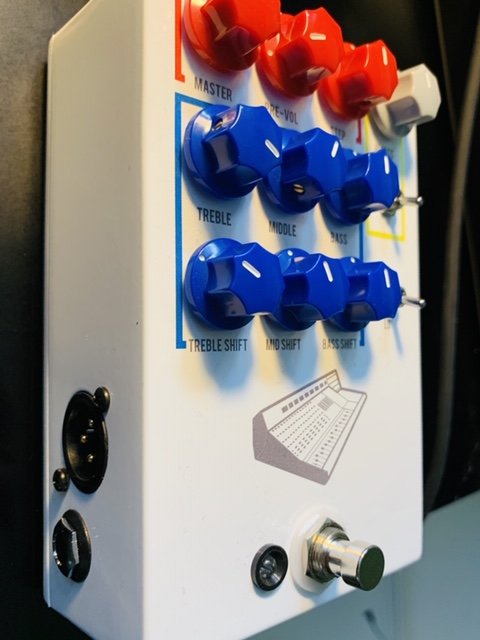
The Gamechanger Audio Plus pedal, which has a giant piano-style sustain foot pedal. It is great for quiet ambient stuff especially because there’s no physical ‘click’ when you engage it. It just feels cool to use and the pedal is great. Very intuitive.

Game Changer Audio Plus Pedal

The main control on this old Westinghouse portable reel-to-reel is beautiful and feels great.

Westinghouse portable reel-to-reel

I’m also a big fan of the Flight of Harmony Choices joystick, which is a eurorack modular synth module. I use it all the time for sound design work.

Flight of Harmony Choices joystick

2. Do you have an ‘almost’ perfect bit of kit? What would you change?
The GR-1 kind of falls into this description because for all it has going for it (which is a lot!) the sample/bank/patch/performance loading and saving scheme for me was not very intuitive and is still taking me a while to get the hang of. That said, I really hate to nitpick. As someone who is friends with many small synth manufacturers, I completely understand that this thing is a product of passion created as a kickstarter project without the resources of a synth giant like Roland or Korg, so hats off to Tasty Chips for making something so great. It takes me a while to get patches and performances set up, but I can work with that because, once those are in place it is super fun to use.

3. What setup do you bring on holiday/tour/commute etc.?
I have a Cordoba Mini which is a nylon string travel guitar, which satisfies the musical urge when away from home.

Cordoba Mini

I also sometimes will bring one of my briefcase modular synths. I’ve converted a few old Samsonite slim briefcases into very portable synths.
If anyone is interested, I did a whole guest blog post about them for my friends at Noise Engineering here.

Noise Engineering Briefcase Eurorack Modular

This thing is thin!

A very thin briefcase modular

I also really love the T. Chordstrum, which is a DIY kit made by Johan Berglund
(https://www.instagram.com/trasselfrisyr) that uses a Teensy board. It is like a tiny Omnichord. It has Korg Mini Pops  drum samples, chord, bass and two sounds for the strum strips. It’s an absolutely fantastic device. It’s my absolute favorite airplane travel instrument.

T. Chordstrum DIY kit

4. What software do you wish was hardware and vice versa?
Back in the ‘80s and ‘90s when all I had was a Yamaha cassette 4-track and a handful of instruments I recorded tons of music. Now, with the incredible technology of a studio on my laptop, I strangely don’t finish as much music. (To be fair to myself, I had a lot more free time then!)
While I absolutely love the capabilities of a modern DAW, there is something about using the computer to record music that hinders me, and I’m not even sure what it is about it. It seems like such a lame thing to say, as I know I am a lucky human being to even have the luxury of owning such equipment, but there’s something about the computer that repels me from even getting started sometimes. I don’t subscribe to the ‘Analog vs. Digital’ mindset, so it’s not that. They are both fantastic for different reasons. (War is over, if you want it!) As a sound designer and musician, I love and use both analog and digital gear.
So I guess what I would really want is something like a standalone Reaper device. A hardware box that I can just turn on and has all the inputs/outputs I need, a few faders and knobs, and a large decent screen. I’ve looked into some of the standalone digital multitrack recorders, but so far nothing has the right appeal. It’s been a while since I’ve looked at what’s available, so maybe I should look into it again.

5. Is there anything you regret selling… or regret buying?
I regret that I traded my first ‘real’ guitar that I ever owned for a Rhodes piano around 2002. It was a 1972 green Fender Mustang with the mint racing stripe (it was actually a blue finish that turns a lovely green over time as the clear coat yellows). I got it in the mid ‘80s for $200. Nirvana hit big a few years later and after that, everybody would see me with this guitar and say, “oh, doing the Nirvana thing, eh?” which was a drag because as much as I liked them, I’d had the guitar for years before the Teen Spirit video. At the time I traded it, I didn’t have the money to get it re-fretted and I wanted a Rhodes, so away it went.
That said, I have always had incredible luck with finding musical equipment at yard sales, swap meets, and thrift stores, for which I am grateful. I have amassed quite a great collection of gear, so I really can’t complain.

6. What gear has inspired you to produce the most music?
As I mentioned earlier, My old Yamaha cassette 4-track was really inspiring and was my training ground that led to me being a professional sound designer and musician. When I first got that and a Midiverb II I was so thrilled. I made music with that set up for years. I still have over 150 cassettes (all numbered and labeled!) from that long period of my life.

7. If you had to start over, what would you get first?
If I could start over, I would have the same gear, but I would embrace music theory and would try harder to learn to read music. I am now, much later in life, getting into studying theory. When I was younger, I avoided music theory because I thought it would just make me sound like everybody else, plus it made that magical musical world I used to intuitively explore feel like more academia. I think there was some merit to exploring on my own, as I came up with some weird cool voicing and songs, etc., but I now feel in the long run, having that knowledge just adds to one’s musical vocabulary.
As far as reading music goes, I may be missing part of my brain because I have a real hard time with it, even though I’ve tried to get into it in earnest many times. I do think the system is pretty terrible though, with the weird staff layouts, sharps and flats, different names for the same notes, and don’t get me started on instruments you have to transpose!

8. What’s the most annoying piece of gear you have, that you just can’t live without?
My iPhone. I use it to record videos and for posting stuff to social media. I use a Roland Go:Mixer Pro to get the audio into it, and randomly the sound will have all these clicks in it, or be super garbled. It’s not the mixer. I’ve found that if I quit all apps, reboot the phone, plug in the mixer, THEN open video app it generally won’t do it.
It’s not lost on me that smart phones are absolutely amazing technology and in the ‘80s these things would have seemed amazing, impossible and alien. It is truly incredible to be alive at a time when you can walk around with a wireless pocket computer with access to all your friends and a global database. But it is funny how frustrating modern technology can be at times!

9. Most surprising tip/trick/technique that you’ve discovered about a bit of kit?
Back around 2001 my home ‘studio’ was pretty humble. I was using minidiscs quite a lot (which I still sort of love, as a format). I discovered with just my Sony MBS-JD920 minidisc deck that not only could you edit tracks, but you could seamlessly loop tracks, and you could program track lists that would play them all without gaps. It was like a primitive DAW! An example of what this enabled would be: recording some drums with my portable minidisc unit with the stereo mic (which had a great compression to it), chopping it up in the deck into the various parts of the song (verse, chorus, etc. ) and then programing the structure (repeating ‘tracks’ as needed), then running the entire full drum track out to the 4-track (to build the rest of the song from there). I also did this with long jams; I would edit them down into more concise songs just using the deck. It was like building a ship in a bottle, but it worked!

[Editor: Cool use of a minidisc. I wonder if the Sony MBS-JD920 has a shuffle mode too?…Glitch generator]


Artist or Band name?
Von Doog

Genre?
All that will have me 🙂

Selfie?

Clark Nova

Where are you from?
I grew up in Michigan and I have lived in California since 1996.

How did you get into music?
I have always loved music and sound. My dad brought home a tape recorder and a 3-pack of blank cassettes from K-Mart and gave it to me when I was five years old. It was the first thing I owned that wasn’t a kid’s toy. I revered it and recorded everything with it.
I got my first guitar when I was eight years old. It was a Kay electric guitar my dad bought for $15 from a classified ad. I plugged it into my stereo. By the time I was 15 I was in a band playing bars in Detroit and Ypsilanti.

What still drives you to make music?
I play music every single day just for personal sanity and enjoyment. For me, music is one of the things that makes life worth living. It’s meditative, too. Sometimes while I’m just playing I’ll start remembering dreams from the night before. I imagine this has something to do with the state I get in while playing is in the similar brainwave range as dreaming, but that’s just a guess. If I were stranded on a deserted island, I’d be making instruments out of coconut shells and anything else I could find just for my own well being.

How do you most often start a new track?
For me, musical ideas usually show up on their own and boss me around. I think of them like children. If you have a kid, you just want to help them be the best version of themselves, not make a mini version of you and project too much onto them. I let songs tell me what they want, even if that means following the muse off a cliff.

How do you know when a track is finished?
I wouldn’t know, I never finish them! Seriously though, when I can listen to the whole track in the car and nothing jumps out at me as needing attention, it’s good to go.

Show us your current studio

The Pyraphonic Studio

Best creative advice that you’ve ever heard?
Thank you for asking me to participate, Martin. At the time of answering these questions, the Corona virus pandemic is happening, so it is a very strange time. I’ve seen people questioning the importance of artistic endeavors while something so heavy is going on, but it is often art and entertainment that can lift us up, and get us through, so my advice is to keep creating.

Promote your latest thing… Go ahead, throw us a link.
My Instagram accounts are where I’m currently most active and will link out to any other stuff I have going on:

Main IG account (Pyraphonic):
https://www.instagram.com/pyraphonic

Music account (Von Doog):
https://www.instagram.com/von_doog/


[Editor: Well said Shawn, with regards to the corona pandemic. It would be interesting to hear how other creatives (:you the reader) responds to the “art isn’t important during times like these” argument? Leave a comment]


Kim Bjorn – The Knobfather

[Editor: I’m very pleased to present to you this interview with a very inspiring person: Kim Bjørn, the author of the wonderful gear books – Patch&Tweak, Push Turn Move and Pedal Crush]

1. Favorite knob/fader/switch on a piece of gear and why?

The mighty On/Off Button

The on/off button. It’s the portal to creativity. Seeing those gear-lights turning on catapults me into an adventurous state of exploration. But I love all knobs so much I could tweak them all day – and my old Sequential Pro-2 had these really nice and interactive pressure-sensitive touch strips.

2. Do you have an ‘almost’ perfect bit of kit? What would you change?

The Moog Grandmother – I’d just replace the spring reverb with a shimmer reverb or a stereo delay. Actually, I did that, but using pedals. Then there’s the Teenage Engineering OP-1. I’ve had it for 8 years now. Add velocity sensitivity and aftertouch, 4 more tracks, multiple FX slots, and better in- and output options, and it’s a winner. However, imperfect bits of kit make for limitations, which usually spark creative thinking – or annoyance if you haven’t been eating for a while.

Moog Grandmother and Teenage Engineering OP-1

3. What setup do you bring on holiday/tour/commute etc.?

My OP-1, a book, iPad and/or laptop – I can cover any work or music gig – and it fits in my backpack. I never commute, go on holiday or tour – and I really can’t make music when I’m on an airplane. I’m usually traveling to a music tech convention, where I then bring my Intellijel 7U travel case with a selection of modules and a couple of pedals, for demonstration and maybe performance.

Kim’s Eurorack Modular

4. What software do you wish was hardware and vice versa?

Spectrasonics Omnisphere as a hardware synth would be amazing. The Sequential Prophet-X is somewhat there, and with a built-in 8-track sequencer/recorder and multitimbrality, it would be amazing. There’s also a lot of VCV-Rack modules that are far more experimental than current Eurorack modules, and would be nice to have as hardware. I’ve never really wanted any hardware in software-form, but having vintage and/or expensive synths in a software version is a really nice option if you can’t afford the real thing (what is “real” anyway?).

5. Is there anything you regret selling… or regret buying?

I miss my old Elektron Octatrack, but the mkII version is not enough to make me re-purchase – I’ll wait for a MkIII miracle. But like Amy Winehouse and William Shatner, I usually don’t regret anything. 

6. What gear has inspired you to produce the most music?

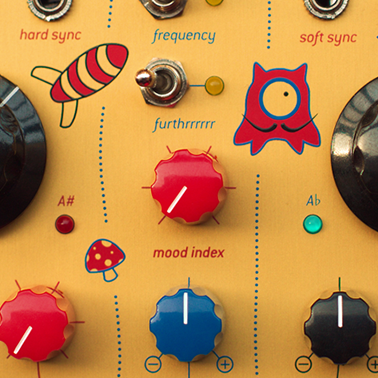
It really depends on how you define the concepts of producing and music. I get inspired by almost every piece of gear to at least produce a squeaky noise. Of course, there’s some that invite towards more jamming, like my TR-8S drum machine, or noodling and creating evolving soundscapes and sequences, like with the modular system. The Elektron sequencing interface has always been a favorite of mine – and even more so with the probability options. The Endorphin.es Furthrrr Generator, Squarp Hermod modular sequencer, Arturia Microfreak, Moog Grandmother, and the Chase Bliss Audio Blooper pedal, are among my top-inspiring friends at the moment though.

7. If you had to start over, what would you get first?

A job. That’s what I did back then. After that, I’d get a Moog One and an 8-track tape recorder. You’d never see me again.

8. What’s the most annoying piece of gear you have, that you just can’t live without?

Snyderphonics Manta
Snyderphonics Manta

I think I sold it – so apparently I can live without it. However, I love my Snyderphonics Manta, but can never remember which hexagons hold what. I guess it leads to what some call improvisation.

9. Most surprising tip/trick/technique that you’ve discovered about a bit of kit?

Teenage Engineering OP-1

I don’t know if it’s surprising, but the first time I ran notes from the OP-1’s Tombola sequencer into a reverb 100% wet to create an evolving soundscape/pad, I got so excited I went out and bought myself a Snickers bar.


Artist or Band name?
Kim Bjørn / Dreamhub

Genre?
Ambient

Selfie?
Can’t find my selfie-stick.

Where are you from?
Copenhagen, Denmark

How did you get into music?
Took piano lessons from age 7, then got an organ and a 4-track tape recorder. The rest is unclear. 

What still drives you to make music?
Curiosity. “What if..?”

How do you most often start a new track?
Dabbling around with no purpose, then grabs a line, sound or sequence. 

How do you know when a track is finished?
When there’s nothing left to take away. Or if I fall asleep while re-listening – it’s ambient after all.

Show us your current studio
I don’t really have one – but there’s some stuff on a table:

Kim Bjørn

Best creative advice that you’ve ever heard?
“A camera is a tool for learning how to see without a camera”.
Translate this to the musical world, and lo and behold…

Promote your latest thing… Go ahead, throw us a link.

Pedal Crush – The wonderful book by Kim Bjørn and Scott Harper

[Editor: Kim, in his humble way, simply offered one link to his latest book Pedal Crush. But trust me, his other books Patch&Tweak and Push Turn Move are equally excellent. Go get’em here.
Kim’s ambient music can be found here on bandcamp


[Editor: There are affiliate links to the relevant gear throughout the articles. It helps to support this blog. In fact, should you be needing some patch cables or guitar strings. Then clicking on one of the above links and buying any product that you prefer, will help the blog… doesn’t even have to be the ones in the link. Thx]


Liam Killen – Killer Beatz

1. Favourite knob/fader/switch on a piece of gear and why?
OPZ knobs are so smooth- they’re the easiest things to spin- easier than any other knob that i’ve seen. It’s quite genius actually! A +  to Teenage Engineering on that design (as per usual).

TE OPZ
Teenage Engineering OPZ

2. Do you have an ‘almost’ perfect bit of kit? What would you change?
Recently I’ve been discovering Arturia’s software synth bundle. Synths/keyboards include: DX7, Jupiter 8V, Fafisa, Prophet V and many more. KILLER and super affordable pack that I would recommend to anyone, I got it off Splice.com
I love me some synth hardware, but I just don’t have the space, budget, time and interest to deal with it and this is an amazing alternative.

3. What setup do you bring on holiday/tour/commute etc.?
I would bring my laptop, just because I can do most of what i’m capable of doing at home with just that- and of course my OP1 because of how portable and easy to use it is. It also makes for a great midi keyboard, instead of using the keys on my laptop. Sometimes I actually prefer a mini set up rather than all of the gear I have at home. 

IMG_1081.jpg
Teenage Engineering OP-1

4. What software do you wish was hardware and vice versa?
I’m beginning to wish that all hardware was software just because of how much easier/less expensive/more accessible it is in that format. That being said, there’s nothing quite like a modular synth, or an OP1 and I don’t think it would ever be possible to replicate it 100% using software (watch it happen this year). Honestly, I don’t have a solid answer to this question right now. I like everything as is, that being said, I feel like a combination of hardware + software is the way to go as a producer in 2020.

5. Is there anything you regret selling… or regret buying?
I recently bought an API lunch box- but then never needed to buy pre amps to go with it. I bought it to record drums, which i’m not really doing much of anymore, because I no longer have a studio to play at. So now it’s just sitting at my friend’s place…collecting dust.
I will say that buying gear is a skill- like all of the gear that I own now, I use, where as when I first started collecting gear, I bought things that I thought were cool, but I didn’t really need. I feel like it’s just something that you have to go through- so just make sure that you take care of your gear so you can resell it when you’re done.

6. What gear has inspired you to produce the most music?
Recently i’ve been using the SP404 a lot and have been composing tunes specifically for the sound and aesthetic of the instrument; so more in the lofi genre. That being said, i’ve been exploring what other genres work and the thing is quite diverse! I recently posted a live set on my Youtube channel, for anyone who’s interested, linked right here below.

Liam Killen killin’ it

7. If you had to start over, what would you get first?
I’m happy with where i’m at now, not sure I would change anything to be honest! I’m glad that I started on drums because it gives me that rhythmic intuition that most people don’t have. Sometimes I do wish that I had started my Youtube channel earlier so that i’d have more of a following, but it takes time and i’m really enjoying the process anyway. I genuinely do love creating videos for you guys and so i’m going to keep doing it!

8. What’s the most annoying piece of gear you have, that you just can’t live without?
I bought a Pocket Operator Modular 400 months ago. The gear itself is not annoying at all…What’s annoying is assembling the thing. I’m pretty sure that the screws that came with it were not the proper ones- so I had to find these tiny little watch screws to put the thing together. Assembling it was probably the most annoying thing that i’ve ever experienced. That being said though, now that it’s all built, it looks so pretty!

Teenage Engineering PO400 and a little Rick and Morty PO35

9. Most surprising tip/trick/technique that you’ve discovered about a bit of kit?
When I was taking drum lessons, my teacher taught me what I think is one of the most important things that i’ve learnt in music- and that’s the long/short note method. I wouldn’t be able to explain it thoroughly over text but it has to do with syncopation of long and short notes and how there’s actual rules to what makes something groove. Basically, Quarter notes are long and so they are accented and syncopated notes followed by a rest are also long- also accented. Everything else is a short note, and there for played as a ghost note. These rules basically revolutionized the way that I think about rhythms and music in general.
In the synth/gear/modular world, these rules are nowhere to be seen, but I try to make them work in my electronic music tracks, which I think helps give me a certain edge. Maybe i’ll get into this in a Youtube video one day now that I think of it… hmmmmmmm. 


Artist or Band name?
Liam Killen

Genre?
That’s a tough question- we’ll say Electronic Music for now. 

Selfie?

Liam Killen
Liam Killen

Where are you from?
Montreal, Canada

How did you get into music?
I always knew I wanted to do something in music but that “something” has changed a lot throughout my life. I started very young at the age of 9 on the drums- my parents bought me a kit because I was constantly banging rhythms on tables. When I was around 15, I became pretty much obsessed with jazz drumming- wasn’t much of a sporty kid so I figured i’d focus my energy on something that I was naturally good at. I ended up going University in jazz performance on drum set- which I graduated from in 2015. I knew I couldn’t make a living off of jazz performance so I branched out during my time in university- played in a million bands, started learning new instruments and eventually got into music production, which i’ve been making a living off of for the past 5-6 years. Just recently though, like in the past 6 months, i’ve really started focusing on creating video content and not just music, and finding my voice and personality over social media, mainly my Youtube channel. I’ve been having a lot of fun with it and it will remain my focus for the foreseeable future. 

What still drives you to make music?
I’ve always been a very motivated person when it comes to music- like i’m really not hard to inspire. Honestly, recently i’ve been listening to less spotify stuff and more to people over social media, like on instagram and youtube and learning from them, which gives me plenty of motivation. I also just feel “at home” when i’m creating- it’s been a solid outlet for me since as long as I can remember, which is why i’ve worked so hard to make it my living. 

How do you most often start a new track?
Recently, i’ve been starting tracks by either programming a solid drum beat that I vibe with, or with a really inspiring sample, whether it’s one of my own or someone else’s. I used to be against using other people’s samples, but if you think about it, the biggest producers in the world do it, so why would wouldn’t I? Why limit myself?
I’ve noticed that the whole sample thing is controversial for some people. So here’s another interesting way to think of it:
My roots are in a band setting. So for me, I was a piece of the puzzle as was everyone else in the band, I was basically a hired gun a lot of the time. So let’s say you use a drum sample in one of your tracks, something that you had no hand in ACTUALLY creating, isn’t that basically the same thing as a band leader hiring a drummer to play drums on his track? That’s sort of the way that I look at it now. And lastly, if it sounds good it’s good! Also it has to be legal, lol. 

How do you know when a track is finished?
I usually like to take a couple of days away from the track when I think that it’s finished. If when I go back to it i’m able to listen through without being “taken out of it” or distracted by an element of the track, that’s when i’m happy. I try to limit myself in that respect though, because it’s easy to go in circles, especially when it comes to the mix, in which case it becomes a waste of time. Just put it out!

Show us your current studio
It’s such a mess right now! My videos look pretty clean, but then when you see behind the scenes, you see how messy it really gets. 

IMG_1075.jpg
Liam’s studio desk
IMG_1076.jpg
E-piano and E-Bass
IMG_1079.jpg
E-Drums and E-Guitars and other guitars

Best creative advice that you’ve ever heard?
I’ve noticed that a lot of people have a hard time getting started- and 90-95% of being prolific is just sitting down at your computer/instrument, and starting. Once you come up with an idea or something that inspires you, you’re in the clear!

Promote your latest thing… Go ahead, throw us a link.
I’m constantly releasing stuff and the best way to keep track is through my social medias. I’m always posting new videos to my Youtube channel and I’m also releasing my first official EP to all listening platforms, so stay tuned for that, out April 7th, 2020. EP cover and Youtube channel linked down below. 

Liam Killen YouTube

CURIOUS final.PNG
LK Curious album cover

[Editor: Liam is obviously a Teenage Engineering fanboi, just like me. But do YOU think that collecting gear from one manufacturer is a good thing or a bad thing, for creating a personal musical style? Leave a comment below]